Everything you need to know about South Lombok’s flagship master-planned community — land prices, villa costs, foreign ownership, rental returns, lifestyle and what to check before you buy.
If you’ve spent any time researching Lombok real estate, you’ve come across Tampah Hills. It’s the development that gets mentioned in every conversation about South Lombok — sometimes with genuine excitement, sometimes with the healthy scepticism that any large foreign-facing project in Indonesia deserves. Both reactions are fair, and both are worth unpacking properly.
This guide is exactly that: a proper unpacking. We’re not the developer and we don’t sell lots at Tampah Hills. What follows is an independent, on-the-ground look at what the project actually is, what land and villas genuinely cost, how foreign ownership works, what rental returns are realistic, and whether it deserves a place on your shortlist. It’s long, because the questions people ask about Tampah Hills deserve real answers — not brochure copy.
What Is Tampah Hills?
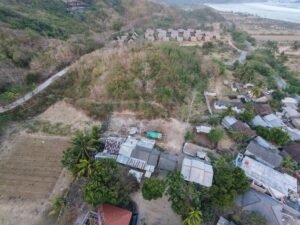
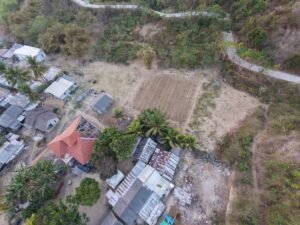
Tampah Hills is a 120-hectare master-planned hillside community on the south coast of Lombok, Indonesia, spread across the lush green ridgelines that rise directly above Tampah Bay. To put that scale in perspective: 120 hectares is roughly 170 football pitches of contiguous hillside, running from elevated ocean-view ridges down toward one of the prettiest and least crowded white-sand bays in South Lombok.
The location is the first thing that makes people pay attention. Tampah Hills sits about 15 minutes’ drive west of Kuta Lombok — the surf-town hub of the south coast and the centre of the government-backed Mandalika development zone — and roughly 30 minutes from Lombok International Airport. That puts it inside the golden triangle of South Lombok property: close enough to Kuta’s restaurants, cafés and nightlife to be convenient, far enough away to feel genuinely private and quiet.
Unlike the piecemeal, lot-by-lot development you see across much of Lombok, Tampah Hills was planned as a single community from day one. The master plan combines residential land lots, architect-designed luxury villas, sports and wellness facilities, restaurants, a co-working space and large tracts of protected green space. The developer’s team includes in-house architects, lawyers, a construction company, landscape designers and a sustainability strategist — a vertically integrated setup that’s rare in Lombok and one of the main reasons the project has attracted a largely international buyer base.
The positioning is deliberately upmarket: this is not a budget land-banking play. Tampah Hills sells serviced, ready-to-build lots and finished designer villas to buyers who want ocean views, build quality that holds up to international standards, and a managed community rather than a solo adventure in Indonesian land ownership.
Why Investors Are Watching Tampah Hills
There are a handful of forces converging on South Lombok right now, and Tampah Hills sits at the intersection of most of them.
Elevated ocean-view land is genuinely scarce
Coastlines everywhere follow the same pattern: the flat beachfront gets developed first, and elevated land with permanent, unblockable ocean views becomes the scarcest asset of all. Bali ran out of it years ago — which is exactly why hillside land in Uluwatu and Bingin now trades at multiples of what it cost a decade back. South Lombok is at a much earlier point on that same curve. Tampah Hills controls one of the largest contiguous holdings of elevated, ocean-facing hillside on the south coast, and scarcity is the backbone of its appreciation story.
Luxury tourism is arriving, not just backpackers
Lombok’s tourism mix is shifting upmarket. Five-star operators have been steadily moving into the south coast on the back of the Mandalika special economic zone, and the MotoGP-hosting Mandalika Circuit — 20 minutes from Tampah Hills — has put South Lombok on a global stage every year since 2021. Luxury travellers need luxury accommodation, and the south coast still has far less of it than demand justifies.
Lifestyle migration and the remote-work wave
The post-2020 shift to remote work permanently changed who buys property in places like Lombok. A meaningful slice of Tampah Hills buyers aren’t pure investors — they’re digital entrepreneurs, remote professionals and families relocating for lifestyle, buying a base in the tropics with rental income as a bonus rather than the whole thesis. Indonesia’s remote-worker visa options and the co-working space inside the development itself both feed this trend.
Surf tourism with world-class consistency
South Lombok is one of the most wave-rich coastlines in Indonesia. Within 30 minutes of Tampah Hills you have Gerupuk’s four reliable breaks, Mawi’s barrels, Are Guling, Selong Belanak’s beginner-friendly beach break and a dozen lesser-known reefs. Surf tourism is year-round, repeat-visit and increasingly affluent — exactly the demand profile a rental villa wants.
A rental market that’s undersupplied at the top end
Kuta Lombok has plenty of guesthouses and mid-range accommodation. What it lacks is genuinely high-end villa stock — the kind of four-to-eight-bedroom, staffed, infinity-pool properties that families and groups pay $400–$1,500 a night for in Bali. The finished villas at Tampah Hills rent into precisely that gap, which is why occupancy at the existing rental villas has been strong enough to anchor the developer’s managed rental program.
Location: Where Exactly Is Tampah Hills?
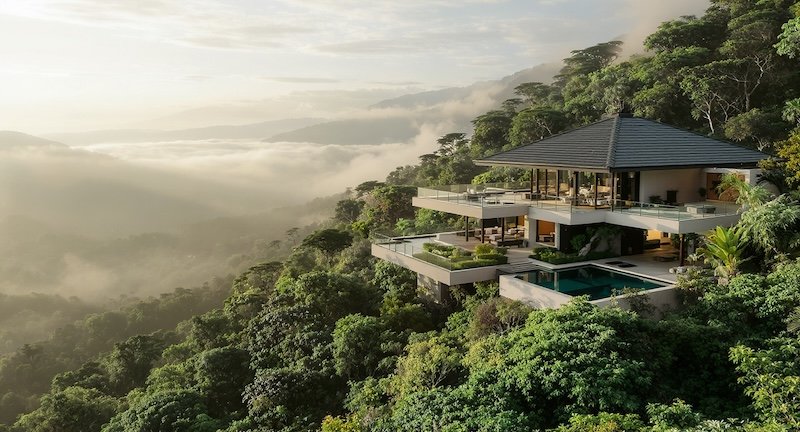
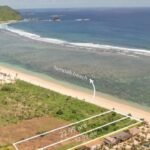
Tampah Hills occupies the hillside directly above Tampah Beach (Pantai Tampah) and neighbouring Lancing Beach, on the stretch of coast between Selong Belanak and Kuta in the Mandalika region of Central Lombok Regency. If you’re looking at a map, find Kuta Lombok, trace the coast road west past Are Guling and Mawun, and you’ll hit Tampah Bay just before Selong Belanak.
Drive times from the development (real-world, not brochure-optimistic):
- Tampah Beach — at the foot of the hill; a few minutes down to the sand
- Lancing Beach — 5 minutes; long, quiet white-sand stretch next door
- Selong Belanak — 10 minutes; Lombok’s most famous learn-to-surf beach and one of its most photogenic bays
- Mawun Beach — 10 minutes; a perfect horseshoe bay for swimming
- Kuta Lombok — 15 minutes; restaurants, cafés, shops, schools, medical clinics, nightlife
- Mandalika Circuit — about 20 minutes; the MotoGP street circuit and the heart of the government’s tourism investment zone
- Gerupuk — 25 minutes; South Lombok’s surf hub with four boat-access breaks
- Lombok International Airport (LOP) — about 30 minutes; direct flights to Singapore, Kuala Lumpur, Jakarta and Bali
The airport connection matters more than most buyers initially realise. Thirty minutes door-to-door from an international airport is closer than most of Bali’s premium villa areas are to Denpasar — Canggu to the airport can take 90 minutes in traffic. For rental guests and for your own visits, that convenience shows up in occupancy and in how often you actually use the place.
The Master Plan: How 120 Hectares Is Laid Out
The thing that separates a master-planned community from a subdivision is what doesn’t get built, and Tampah Hills leans into that. A significant share of the 120 hectares is reserved as permanent green space — parkland, community gardens, walking and trail networks — so the hillsides never fill in wall-to-wall with construction the way unplanned areas of Bali did.
The residential land is organised into staged zones, each with its own character:
- Stage 1 and Stage 2 — the original releases, facing directly over Tampah Bay. These are the most established zones, where most of the completed villas stand, and only a limited number of lots remain.
- Stage 3 and Stage 4 — newer, higher-elevation releases set near the parklands and rice fields, with premium sunrise and panoramic views across the hills and ocean.
- Beachfront lots — a small, genuinely rare release of oceanfront land at the base of the development.
Community amenities built or planned within the master plan include:
- A sports centre with padel courts (billed as among Indonesia’s first), tennis, beach volleyball and a football pitch
- Restaurants serving the community and rental guests
- A spa and gym for wellness-focused residents and guests
- A co-working space — a genuine draw for the remote-work crowd
- Community gardens growing produce for residents and the restaurants
- Walking and mountain-bike trails threading through the green zones and down to the beaches
- Yoga pavilions and regular community classes
Every serviced lot comes with infrastructure already in the ground: sealed road access, power, water and high-speed internet. That sounds unremarkable until you’ve priced running utilities up a raw Lombok hillside yourself — infrastructure is routinely the hidden five-figure cost that catches out independent land buyers, and it’s already absorbed into serviced-lot pricing here.
The Villas: Architecture, Quality and What You’re Actually Buying
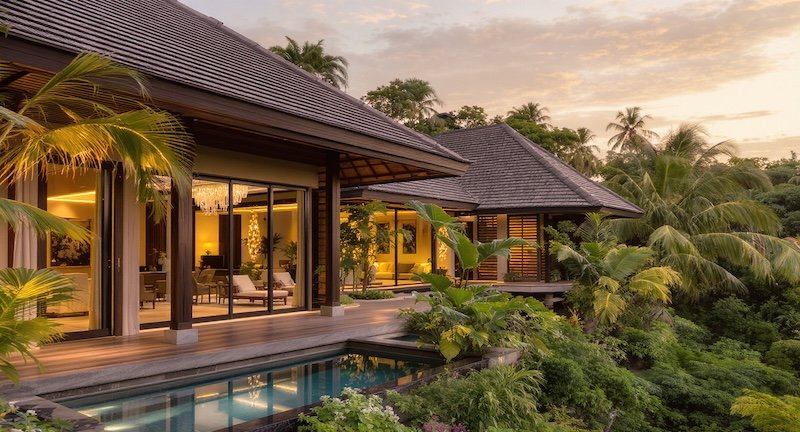
The villas are where Tampah Hills has built its reputation. There are now well over a dozen completed architect-designed homes across the estate — names like Villa Awasi, Villa Kami, Villa Mentari, the House of Herring and the sixteen-sleeper Villa Kastil Utara — and several have been featured in international architecture and travel press. They range from intimate two-bedroom homes up to full family compounds sleeping sixteen.
Design language
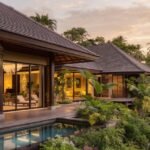
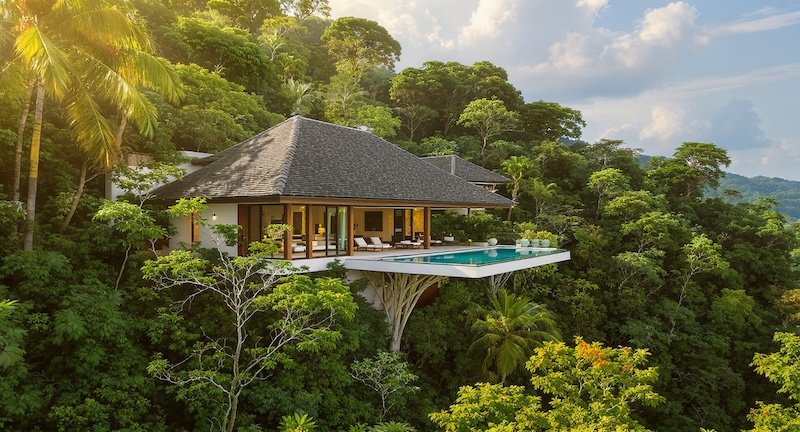
The architecture is modern tropical: long timber roofs inspired by traditional Indonesian building forms, deep shaded verandas, walls that slide away entirely so living areas open to the view, and infinity pools cantilevered toward the ocean. Materials lean local and sustainable — timber, natural stone, bamboo detailing — and the in-house architectural team designs each villa to sit into its hillside rather than on top of it. Roof gardens and planted terraces are a recurring signature; from the air, several villas nearly disappear into the green.
Indoor-outdoor living, done properly
Every villa is organised around the ocean view and the breeze. Open-plan living pavilions, outdoor dining, day beds by the pool, and bedrooms with floor-to-ceiling glass are standard. Interiors are finished to genuine five-star standard — custom joinery, premium fixtures, curated furniture — because most villas double as luxury rental stock and are judged nightly by paying guests.
Services that come with the community
Completed villas in the rental program operate with private chefs (breakfast cooked in-villa is standard), butler service, housekeeping, airport transfers and access to all the estate amenities. For owners, the developer offers full property management — maintenance, staffing, marketing and guest management — so a villa here can be entirely hands-off between your own visits.
Building your own
Buy a lot and you can commission your own villa, either with the in-house architecture and construction team or — subject to the estate’s design guidelines — with your own architect. Construction with the estate’s team is quoted from roughly US$1,300 per square metre, which positions it above cheap local building (where quality is a lottery) and below what comparable architect-led builds cost in Bali. Design guidelines govern building heights, footprint and materials so no one’s view gets built out and the estate keeps its architectural coherence — a restriction that protects your resale value far more than it constrains your creativity.
Land at Tampah Hills: Lots, Stages and Prices
Land is the entry point for most investors, and it’s where the numbers deserve the most scrutiny.
What’s on offer
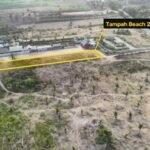
Lots are sold serviced and ready to build, with road, power, water and internet connected. Typical residential lots run from roughly 1,700 m² up to 4,800 m², with some larger parcels extending well beyond that for buyers wanting estate-scale privacy. The staged releases mean there’s a spread of price points: remaining Stage 1–2 lots with established surroundings and direct bay views, newer Stage 3–4 releases higher on the hill with panoramic sunrise views, and a handful of premium beachfront lots.
What it costs
Pricing is per-lot rather than a flat rate, and it moves with each release — so treat published numbers as a snapshot. As a working range in 2026, land in the Tampah/Torok corridor trades from roughly US$60 per m² for unserviced land in the wider area up to US$200+ per m² for prime serviced ocean-view lots inside the estate, with beachfront commanding premiums above that. On a typical 2,000 m² ocean-view lot, that puts realistic all-in land budgets in the US$250,000–US$450,000 bracket before building. Add villa construction from US$1,300/m² and a finished 300 m² home lands somewhere between US$650,000 and US$1 million depending on lot, size and spec.
Budget for transaction costs on top: Indonesian property sales carry a 5% buyer’s tax (BPHTB), plus notary fees and the cost of issuing the land certificate — none of which are included in list prices.
The appreciation case
The long-term argument for Tampah Hills land is the same one that played out in Bali: elevated ocean-view land near an international airport, inside a maturing tourism economy, with fixed supply. South Lombok land prices have risen consistently since the Mandalika project broke ground, and serviced estate land has outperformed raw land because the infrastructure, legal cleanliness and community amenities compound the underlying location value. Nobody can promise you a growth rate — anyone who does should worry you — but the structural drivers (scarcity, airport proximity, Mandalika investment, undersupplied luxury stock) are unusually well-aligned here.
Privacy and buildability
Large lot sizes and the green-space buffers mean villas don’t sit shoulder-to-shoulder. Combined with the design guidelines, that gives Tampah Hills something genuinely hard to find in Indonesian coastal development: confidence that the lot you buy for its view will still have that view in ten years.
Foreign Ownership at Tampah Hills, Explained Properly
This is the section to slow down on. Indonesian property law is different from what most foreign buyers are used to, and understanding your ownership structure matters more than any other decision you’ll make. Here’s the honest version.
The baseline: foreigners cannot hold freehold
Indonesian freehold title (Hak Milik) is reserved for Indonesian citizens. Full stop. Any structure that promises a foreigner “freehold” — including the notorious nominee arrangements where an Indonesian citizen holds title on your behalf — is either mislabelled or legally fragile. Nominee structures in particular have been repeatedly struck down by Indonesian courts. If a seller anywhere in Lombok offers you nominee freehold, walk away.
HGB: the title Tampah Hills uses
Hak Guna Bangunan (HGB) — “right to build” — is the title structure Tampah Hills offers, and it’s the same instrument used by virtually every serious commercial development in Indonesia, from Jakarta office towers to Bali’s five-star resorts. HGB is a registered, certificated, bankable title issued for an initial term (typically 30 years), extendable by 20 years and renewable again, giving effective tenure of up to 80 years. It can be legally held by a PT PMA — a foreign-owned Indonesian limited company — which is the standard vehicle for foreign property investors in Indonesia.
In practice, the typical Tampah Hills structure looks like this: you establish a PT PMA (the estate’s legal team assists, or you use your own counsel), the PT PMA holds the HGB certificate over your lot, and you own the PT PMA. The result is registered, renewable, transferable and inheritable control of the land through a structure that is explicitly designed for foreigners under Indonesian law — not a workaround.
Hak Pakai: the personal-use alternative
Hak Pakai (“right to use”) is a title foreigners can hold in their own name if they have an Indonesian residence permit (KITAS/KITAP). It suits buyers purchasing purely as a personal residence. It’s less flexible for rental businesses — which is why most investment buyers use the PT PMA + HGB route instead.
Leasehold: the simpler, cheaper entry
Traditional leasehold (25–30 years, often with extension options) remains common across Lombok and is a legitimate, simpler structure for smaller budgets. The trade-off is a wasting asset: a lease’s value declines as its term runs down, whereas HGB is renewable and behaves much more like ownership. For a long-term hold at Tampah Hills price points, HGB through a PT PMA is the structure that fits.
Due diligence: what to verify before signing anything
- Certificate check — have an independent notary (PPAT) verify the parent certificate at the National Land Agency (BPN): who holds title, its exact boundaries, any encumbrances or mortgages.
- Zoning — confirm the land is zoned for residential/tourism use and that building permits (PBG, the successor to IMB) can be issued.
- The developer’s own structure — confirm how the master estate holds its land and how your lot’s title is carved out and transferred.
- Independent legal counsel — the estate’s in-house lawyers are competent, but you should still have your own lawyer reviewing everything. Any developer that resists independent review is telling you something.
The legal process, step by step
- Reserve the lot and sign a booking agreement with deposit
- Due diligence period — certificate, zoning and structure verification
- Establish the PT PMA (4–8 weeks, can run in parallel)
- Sign the sale and purchase deed (AJB) before a notary/PPAT
- Pay the 5% buyer’s tax (BPHTB); the seller pays their own 2.5% transfer tax
- BPN registers the HGB certificate in the PT PMA’s name
Taxes and ongoing costs to budget
- BPHTB — 5% buyer’s tax on acquisition
- Notary and certificate fees — typically ~1–2.5% combined
- Annual land and building tax (PBB) — modest by international standards
- PT PMA compliance — annual accounting/reporting, roughly US$1,500–3,000/year with a good agent
- Rental income tax — 10% final withholding on gross rental income for a PT PMA electing final-tax treatment; get current advice, rates and regimes change
Financing
Be realistic: Indonesian banks do not lend to foreign buyers in any practical sense. The market is overwhelmingly cash, though developers (Tampah Hills included) commonly offer staged payment plans across the purchase and construction period, which is the de facto financing route. Some buyers borrow against home-country assets instead. Factor this in early — it shapes what you can buy.
Rental Potential: What Returns Are Realistic?

Tampah Hills operates a managed rental program: the estate’s hospitality team markets your villa, manages guests, staffs it (chef, housekeeping, butler service) and maintains it, on a revenue split of 60% to the owner, 40% to management. The developer’s projections put owner returns at roughly 4–10% net yield at around 50% occupancy, depending on villa size and spec.
Treat those figures the way you should treat every developer projection: as an estimate to stress-test, not a promise. That said, the underlying demand story is real, and it comes from several directions at once:
- Luxury holiday rentals — the core market. High-end family and group travel to South Lombok is growing off a small base of quality supply; staffed ocean-view villas at Tampah Hills sit at the very top of what’s available and command nightly rates of several hundred dollars up to four figures for the largest homes.
- Surf tourism — year-round, repeat-visit demand from an increasingly affluent crowd, with a dozen world-class breaks within half an hour.
- Digital nomads and remote workers — the co-working space and monthly-stay demand smooth out shoulder seasons in ways pure holiday markets don’t.
- Wellness retreats — yoga and wellness groups block-book large villas for a week at a time; the spa, yoga facilities and quiet setting fit this market unusually well.
- Corporate retreats — the large villas (10–16 sleepers) plus co-working, sports facilities and airport proximity make Tampah Hills a credible team-offsite venue.
- Event spikes — MotoGP week at Mandalika sells out the south coast’s quality stock at premium rates every year.
When you run your own numbers, model conservatively: assume occupancy in the 40–55% band, subtract the management split, staffing-related costs, utilities, maintenance reserves (tropical climates chew through buildings), PT PMA compliance and the 10% rental tax. A well-run large villa here can plausibly clear the middle of the projected range; a poorly specified or overpriced one won’t. The variables you control — build quality, interior spec, bedroom count and photography — matter as much as the location you’re buying into.
The Lifestyle: What Living at Tampah Hills Is Actually Like
Investment cases get people to Lombok; lifestyle is what keeps them here. A representative week at Tampah Hills looks something like this:
- Surfing — dawn sessions at Mawi when the swell’s up, mellow longboard waves at Selong Belanak ten minutes away, boat trips out to Gerupuk’s reefs. South Lombok surf works year-round: outer reefs in the dry season, protected bays in the wet.
- Padel and tennis — the estate’s padel courts were among the first in Indonesia and have become a genuine social hub; there’s a friendly competitive scene among owners and long-stay guests.
- Yoga and wellness — regular classes, ocean-view sessions, the spa for post-surf recovery.
- Mountain biking and trail walking — the estate’s own trail network runs through the green zones, and the surrounding hills offer endless riding through villages and rice fields.
- Diving and snorkelling — the south coast’s reefs are underrated, and the Gili Islands and Belongas Bay (hammerheads, for the brave) are day-trippable.
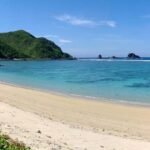
- Beaches — this is the headline. Tampah, Lancing, Mawun, Selong Belanak, Are Guling: five distinct white-sand beaches within ten minutes, most of them near-empty on any given weekday.
- Food — the estate’s restaurants cover daily needs; Kuta’s genuinely good and fast-improving restaurant scene is 15 minutes away; your private chef covers everything else.
- Golf — Rinjani Country Club’s 18 holes are about an hour north for the dedicated.
- Community — this is the under-appreciated part. Tampah Hills has a real residential community: families, entrepreneurs, retirees and remote workers from a couple of dozen countries, plus community gardens, shared dinners and sports leagues. For anyone relocating with kids or moving solo, that built-in social fabric is worth more than any amenity.
The honest caveats: South Lombok is still developing. International schooling options around Kuta are young and growing, serious medical care means Mataram (90 minutes) or a flight to Bali, and you’ll want your own transport. This is a frontier that’s civilising quickly — that’s exactly why the investment case exists — but it isn’t Seminyak, and people who need Seminyak should buy in Seminyak.
Nearby Attractions and Areas Worth Knowing
Every one of these deserves its own deep-dive (and each links to our full guide):
- Kuta Lombok — the south coast’s hub town: cafés, restaurants, nightlife, coworking and the centre of the Mandalika zone. 15 minutes east.
- Tampah Beach — the white-sand bay at the foot of the development; quiet, swimmable and effectively the estate’s front yard.
- Selong Belanak — a postcard horseshoe bay and Lombok’s best learn-to-surf beach, with a growing strip of beach clubs and warungs. 10 minutes west.
- Mawun Beach — a perfect half-moon swimming bay between two headlands. 10 minutes east.
- Mandalika — the government’s special economic zone and MotoGP circuit driving billions in infrastructure investment into the south coast. 20 minutes east.
- Gerupuk — fishing village turned surf hub with four boat-access breaks working on every tide. 25 minutes east.
- Are Guling — quieter surf beach with left and right reef breaks and a fast-growing villa scene. 10 minutes east.
- Mawi — South Lombok’s most famous barrel, a short drive west; advanced surfers only.
- Merese Hill — the sunset viewpoint over Tanjung Aan that fills every Lombok Instagram feed. 25 minutes east.
The Independent Verdict
Is Tampah Hills legitimate? Yes — it’s an established development with completed, operating villas, registered titles, an international owner base and years of delivery behind it. That alone separates it from a large share of what gets marketed to foreigners in Lombok.
Is it right for you? That depends on what you’re buying for. If you want the cheapest possible entry into Lombok land, Tampah Hills isn’t it — you’re paying a premium for infrastructure, legal cleanliness, design control and community. If you want raw land speculation, buy raw land and accept the risks that come with it. But if you want elevated ocean-view property in South Lombok with defensible title, real build quality, a functioning rental engine and a community you’d actually enjoy living in, Tampah Hills is on a very short list — arguably a list of one at this scale.
As with everything in Indonesian property: verify independently, model conservatively, and get your own lawyer. The opportunity in South Lombok is real. So is the need to do it properly.
Tampah Hills: Frequently Asked Questions
Legitimacy and basics
Is Tampah Hills a legitimate development?
Yes. Tampah Hills is an established 120-hectare master-planned development with more than a dozen completed, operating luxury villas, registered land titles, an in-house legal and construction team and an international owner community. It has been selling and delivering since well before the current South Lombok boom.
Who is behind Tampah Hills?
The project is run by an international development team with in-house architects, lawyers, a construction company, landscape designers and a sustainability strategist, alongside a hospitality team that operates the rental villas.
How big is Tampah Hills?
Approximately 120 hectares of hillside above Tampah Bay, developed in stages with large areas reserved as permanent green space.
Where exactly is Tampah Hills?
On Lombok’s south coast, directly above Tampah Beach between Selong Belanak and Kuta Lombok — about 15 minutes from Kuta and 30 minutes from Lombok International Airport.
How far is Tampah Hills from the airport?
Roughly 30 minutes by car from Lombok International Airport (LOP), which has direct flights to Singapore, Kuala Lumpur, Jakarta and Bali.
How far is Tampah Hills from Kuta Lombok?
About 15 minutes’ drive along the south coast road.
Ownership and legal
Can foreigners buy property at Tampah Hills?
Yes. The standard structure is HGB (Hak Guna Bangunan) title held through a PT PMA — a foreign-owned Indonesian company — which is the same legally recognised structure used by major commercial developments across Indonesia.
Is Tampah Hills leasehold or freehold?
Neither in the traditional sense: lots are sold with HGB (“right to build”) title, which runs for an initial 30-year term, extendable by 20 and renewable again — up to around 80 years of registered, certificated tenure that behaves far more like ownership than a standard 25-year lease.
What is HGB title?
Hak Guna Bangunan is an Indonesian registered land title granting the right to build on and use land. It is certificated by the National Land Agency (BPN), transferable, inheritable, mortgageable and renewable — and it can be held by a foreign-owned PT PMA company.
What is a PT PMA and do I need one?
A PT PMA is a foreign-investment limited company in Indonesia. It’s the standard vehicle for foreign property investors because it can legally hold HGB title and run a rental business. Setting one up takes roughly 4–8 weeks; the estate’s legal team or your own counsel can handle it.
Can I buy in my own name instead of a company?
Foreigners with an Indonesian residence permit (KITAS/KITAP) can hold Hak Pakai (“right to use”) title personally, which suits pure personal-use purchases. For rental investment, the PT PMA + HGB route is more flexible.
Are nominee structures safe?
No. Arrangements where an Indonesian citizen holds freehold title on a foreigner’s behalf have been repeatedly invalidated by Indonesian courts. Tampah Hills does not use nominee structures, and neither should you — anywhere.
What taxes do I pay when buying?
Buyers pay 5% acquisition tax (BPHTB) plus notary and certificate fees — typically another 1–2.5% combined. These are not included in list prices.
What are the ongoing taxes and costs?
Annual land and building tax (PBB, modest), PT PMA accounting and compliance (roughly US$1,500–3,000/year), and 10% final withholding tax on gross rental income under the standard regime. Get current advice — Indonesian tax rules evolve.
Is financing available?
Indonesian banks don’t practically lend to foreign buyers, so the market is cash-based. Tampah Hills, like most developers, offers staged payment plans across purchase and construction, which is the usual financing route. Some buyers borrow against home-country assets.
Should I use my own lawyer?
Yes — always, for any Indonesian property purchase. The estate has in-house legal support, but independent verification of the certificate, zoning and transaction documents is basic due diligence.
Land and building
How much does land cost at Tampah Hills?
Pricing is per lot and per release, but as a 2026 working range, serviced ocean-view lots inside the estate trade up to US$200+ per m², against roughly US$60+/m² for unserviced land in the wider Tampah/Torok area. A typical 2,000 m² ocean-view lot lands in the US$250,000–450,000 bracket.
What lot sizes are available?
Most residential lots run from about 1,700 m² to 4,800 m², with some larger estate-scale parcels available. A limited number of beachfront lots exist at the base of the development.
What are the development stages?
Stages 1 and 2 face directly over Tampah Bay and are largely built out; Stages 3 and 4 sit higher near the parklands and rice fields with panoramic sunrise views; plus a small beachfront release.
Are the lots ready to build?
Yes — serviced lots come with sealed road access, power, water and high-speed internet already connected.
Can I build my own villa?
Yes. You can build with the estate’s in-house architecture and construction team or, subject to the design guidelines, engage your own architect.
Can I choose my own architect?
Generally yes, provided the design complies with the estate’s building guidelines covering height, footprint and materials — rules that exist to protect every owner’s views and the estate’s coherence.
How much does it cost to build?
Construction with the estate’s team is quoted from around US$1,300 per m². A finished 300 m² villa typically lands between US$650,000 and US$1 million all-in including land, depending on the lot and specification.
How long does a villa build take?
Plan on roughly 12–18 months from design sign-off to completion for a typical villa, depending on size and complexity.
Are there building guidelines?
Yes — height, footprint, setback and material guidelines apply across the estate so that no construction blocks a neighbour’s view. This is a feature, not a bug: it protects your view and your resale value.
Is the construction quality good?
The completed villas are the best evidence: architect-designed homes featured in international design press, built by the estate’s own construction company and operating successfully as five-star rental stock, where paying guests audit the quality nightly.
Rental and returns
Can I rent out my villa?
Yes. The estate runs a managed rental program — marketing, guest management, staffing and maintenance — on a 60/40 revenue split in the owner’s favour. You can also self-manage or use a third-party operator.
What rental returns can I expect?
The developer projects roughly 4–10% net yield at around 50% occupancy depending on villa size and spec. Treat projections as estimates: model conservatively at 40–55% occupancy, net of the management split, operating costs and 10% rental tax.
How much do villas rent for per night?
Established villas at Tampah Hills rent from several hundred US dollars a night for smaller homes up to four figures for the largest (10–16 sleeper) villas in peak periods such as MotoGP week.
Who rents villas in South Lombok?
Luxury holiday travellers and families, surf groups, digital nomads on monthly stays, yoga and wellness retreats, corporate offsites, and event traffic around the Mandalika MotoGP.
Can I use my villa myself?
Yes — the rental program allows flexible personal usage; you block out your own dates and the villa earns when you’re away.
How much are maintenance and management fees?
Under the managed program, the 40% management share covers marketing, guest operations and day-to-day staffing. Owners should additionally budget maintenance reserves — tropical buildings need continuous upkeep — plus utilities and insurance. Get the current fee schedule in writing before purchase.
Lifestyle and practicalities
What amenities does Tampah Hills have?
Padel and tennis courts, beach volleyball, a football pitch, spa and gym, restaurants, a co-working space, community gardens, yoga classes, and walking and mountain-bike trails through the estate’s green zones.
Is there security?
Yes — the estate operates as a managed community with controlled access and on-site staff, one of the practical advantages over standalone villa ownership in the countryside.
Is there good internet?
Yes — high-speed internet is part of the estate infrastructure, and the co-working space is built for remote work. South Lombok’s 4G coverage is solid and improving.
Which beaches are closest?
Tampah Beach sits directly below the estate, with Lancing Beach next door and Selong Belanak, Mawun and Are Guling all within about ten minutes.
Is Tampah Hills good for surfers?
Exceptionally. Selong Belanak (beginner), Mawi (advanced barrels), Are Guling, Gerupuk’s four breaks and a string of lesser-known reefs are all within 10–30 minutes, working year-round across seasons and tides.
Can families live at Tampah Hills full-time?
A growing number do. The community includes resident families, and schooling options around Kuta are developing. Serious medical care currently means Mataram (about 90 minutes) or Bali — a real consideration for full-time family relocation.
What is the weather like in South Lombok?
Tropical and drier than Bali: a dry season roughly May–October and a green season November–April with short, heavy showers. South-coast Lombok is one of the sunnier corners of Indonesia.
Is Lombok safe?
Lombok is generally very safe, with low crime by regional standards and a famously welcoming Sasak culture. Standard travel common sense applies; within a managed estate like Tampah Hills, security is a non-issue day to day.
Why choose Tampah Hills over buying land independently in Lombok?
Clean, verified HGB title; infrastructure already installed; design rules protecting your views; build quality with accountability; a managed rental engine; and community amenities. You pay a premium over raw land for all of it — that premium is the price of removing most of the classic Lombok land-buying risks.
How does Tampah Hills compare to investing in Bali?
Bali offers a mature market with proven rental demand but high land costs and saturation in prime areas. South Lombok offers Bali-a-decade-ago pricing with the Mandalika infrastructure wave still building, at the cost of a younger tourism market. Tampah Hills is effectively the “institutional quality” way to take the Lombok side of that bet.
What should I do before visiting or buying?
Visit in person — the drive from the airport tells you half the story. Walk the actual lot lines, ask for the current price list and title documentation, tour the operating rental villas, and engage an independent Indonesian property lawyer before signing anything.