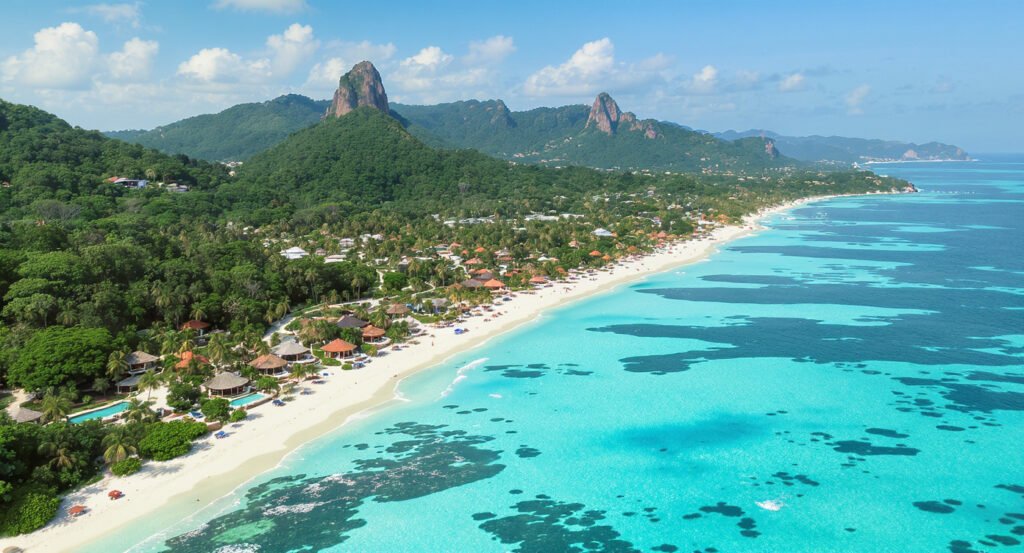
Lombok’s property market in 2026 is at an inflection point. Infrastructure that was speculative in 2020 is now operational. The Mandalika Special Economic Zone is producing measurable rental returns. Tourism arrivals are running at five times their pre-COVID rate and growing at 25–35% annually. And entry prices are still 40–60% below comparable Bali inventory.
This guide is the complete picture for Lombok real estate investment: market fundamentals, yield data by location, legal structures for foreign buyers, the step-by-step buying process, and the real risks that need to be in your due diligence model. Everything here is referenced to 2026 data.
If you have a specific property in mind, the Lombok ROI Calculator lets you model gross yield, net yield, and 5-year total return in under 2 minutes. Run the numbers first, then use this guide for context.
Why Lombok Real Estate Investment Makes Sense in 2026
The investment case for Lombok rests on four structural drivers that have all materialised since 2022:
1. The Mandalika catalyst is real and measurable. The USD 3B+ Mandalika Special Economic Zone is not a future promise. It is a live, operating, internationally-recognised venue. The Pertamina Mandalika International Street Circuit hosted MotoGP rounds in 2023 and 2024, generating over 100,000 visitor arrivals each year. The infrastructure investment is complete in its core phases.
2. The price gap to Bali remains wide. Entry villas in Lombok’s growth corridors start at USD 150,000–350,000. Comparable Bali product starts at USD 400,000–700,000. Land in the Mandalika zone trades at approximately USD 120–215/m² versus USD 1,500–3,000/m² in prime Bali zones. That differential narrows as the market matures — the current window captures it before normalisation.
3. Tourism growth is structural, not seasonal. Lombok International Airport recorded approximately 700,000–800,000 international arrivals in 2024, growing at 25–35% year-on-year. Bali, by comparison, is growing at 5–7%.
4. Appreciation is already documented. Lombok villa properties have appreciated at 15–20% CAGR over the past five years. Mandalika land moved 20–25% in 2024. For the full data history, see the Lombok property market analysis (2020–2026).
Lombok Real Estate Investment: Prices and Yields by Zone
| Zone | Entry villa (2-bed) | Gross yield | Net yield | 5yr CAGR |
|---|---|---|---|---|
| Kuta / Mandalika | USD 150k–500k | 12–18% | 6–10% | 15–20% |
| Selong Belanak | USD 120k–300k | 10–15% | 5–8% | 12–16% |
| Gili Islands | USD 200k–600k | 10–14% | 4.5–7% | 8–12% |
| Senggigi / North | USD 50k–200k | 7–12% | 3–6% | 8–12% |
For a full breakdown of yields including occupancy benchmarks, management cost workings, and gross-to-net scenarios, read the Lombok Rental Yield Guide.
Legal Structures: How Foreign Investors Hold Lombok Property
Indonesian property law reserves freehold land title (Hak Milik) for Indonesian citizens. Foreign buyers access property through three legal routes.
PT PMA — Best for Rental Investment
A PT PMA (foreign-owned limited liability company) holds property under Hak Guna Bangunan (HGB). This is the only legal structure that permits commercial rental income for foreigners — including Airbnb, villa rentals, and short-stay accommodation. Foreign investment companies are registered through BKPM (Indonesia Investment Coordinating Board). Setup cost: IDR 30–80M (~USD 1,850–4,900). Annual compliance: IDR 20–50M/year. Title term: up to 80 years renewable.
Hak Pakai — Personal Residence Only
Direct personal ownership in the foreigner’s name. Simpler and cheaper — but commercial rental is prohibited. Requires an Indonesian residential visa. Limited to one property per individual.
Leasehold (Hak Sewa) — Entry-Level
A contractual lease, typically 25–30 years with extension options. No title — only contractual rights. Lowest cost entry for lifestyle or budget acquisitions.
For a detailed cost comparison including 5-year financial modelling of each structure, read PT PMA vs Hak Pakai: Which Structure Is Right for You?
The Buying Process for Foreign Investors
The full Lombok real estate investment purchase process for a foreign buyer via PT PMA runs approximately 8–14 weeks across three phases:
- Pre-purchase due diligence — engage an independent notaris, verify land title, confirm no encumbrances, sign Letter of Intent with deposit
- PT PMA formation — company deed, OSS/BKPM registration, NPWP, NIB, bank account (can run in parallel)
- Completion — Sale and Purchase Agreement (AJB) executed, BPHTB (5% transfer tax) paid, HGB certificate issued to the PT PMA
Transaction costs (buyer): approximately 10–15% of purchase price, covering transfer tax, stamp duty, notaris fees, and agent commission. For the complete process with due diligence checklist, read How to Buy Property in Lombok as a Foreigner.
Risk Assessment: Lombok Real Estate Investment in 2026
Title risk. Independent title verification through a reputable notaris before any purchase is non-negotiable. Never skip this step.
Management quality risk. Occupancy projections in developer brochures frequently assume 65–70% — achievable for well-managed, prime-zone properties; optimistic for secondary locations. Year 1–2 often runs 10–15 percentage points below projections.
Liquidity risk. Lombok is not Bali. Selling quickly may require a price concession. A 5–7 year minimum horizon is appropriate for Lombok real estate investment.
Regulatory consistency. Zoning decisions, short-stay rental rules, and building permit processes change. Work with local advisers who have current knowledge. The 7 mistakes foreign investors make in Indonesia covers the most common and costly errors.
Lombok vs Bali: The Lombok Real Estate Investment Case
| Bali (established zones) | Lombok (Kuta/Mandalika) | |
|---|---|---|
| Entry villa (2-bed) | USD 350k–700k | USD 150k–400k |
| 5-year appreciation CAGR | 4–6% | 12–18% |
| Net rental yield | 3–4% | 6–10% |
| Tourism growth (YoY) | 5–7% | 25–35% |
| Market saturation | Moderate-High | Low-Moderate |
For a full side-by-side comparison including investor scenarios and total return modelling, read Bali vs Lombok Property Investment: Which Wins in 2026?
Conclusion: The Lombok Real Estate Investment Window
The Lombok real estate investment case in 2026 is the combination of: infrastructure now proven and operational, entry prices still 40–60% below Bali equivalents, tourism growth running at 5× Bali’s rate, net yields 2–3× Bali’s established zone returns, and a documented appreciation cycle with meaningful runway remaining.
This window is finite. Emerging markets do not stay in the early-growth phase indefinitely. The price gap to Bali narrows as the market proves itself. The investors who act in 2025–2027 are still in the productive part of the cycle — before normalisation compresses the entry advantage.
Use the Lombok ROI Calculator to model your specific scenario before any further research. Download the free Lombok Investment Guide (PDF) for a printable due diligence checklist and buying process summary.
This article is for informational purposes only. It does not constitute financial, legal, or investment advice. Property investment carries risk including loss of capital. Always conduct independent due diligence and consult a qualified Indonesian notaris and financial adviser before making investment decisions.

Author: Brusca
Living in Indonesia for 15 years, with hands-on experience in how the Indonesian real estate industry actually works. Lombok is currently the fastest-growing property market in Southeast Asia. Every listing on this site is vetted where timing allows.




Leave a Reply