TetebatuAI-Powered Investment Intelligence
AI-Generated · Updated 23 Aug 2026Investment Overview
Tetebatu in East Lombok has rapidly evolved from a low-traffic rural destination into one of the regency’s flagship tourism villages, with recorded overnight visitors increasing from only 107 in 2022 to 19,742 in 2024 and 21,107 in 2025[1]. This exponential growth, combined with recognition as a Desa Wisata Tetebatu on the national tourism village platform, positions the area as an early-stage eco-tourism cluster with room for further expansion[1][9].
The investment value proposition is built on nature-based tourism (rice terraces, waterfalls, Rinjani foothills), relatively low current land values compared with coastal Lombok, and a deeply local homestay ecosystem that can be upgraded into higher-yield boutique accommodation[2][4][7][11][13]. Strong foreign visitor dominance from 14 countries, led by European markets, suggests resilient demand from long-haul travellers who typically stay longer and are less price-sensitive than domestic visitors[1][6]. Overall, Tetebatu currently merits an investment grade of medium–high (around B+ in risk-adjusted terms): upside from tourism and land-price growth, but tempered by liquidity constraints, limited infrastructure, and regulatory complexity for foreign buyers.
For investors, Tetebatu offers a classic “emerging micro-market” profile: tourism data confirm real demand, yet the built environment remains dominated by small family homestays rather than institutional-grade assets[2][4][8][11][13]. This allows value creation through professional design, branding, and yield management, especially in eco-lodges and view villas, before larger regional capital fully prices in the area’s potential.
Tourism Trends
Available data show exceptionally strong growth in Tetebatu’s visitor base over the past five years, albeit with differing measurement scopes across sources[1][6][12][15]. One study records total visitors rising from 137 in 2020 to 421 in 2021, 619 in 2022, and 879 in 2023, reflecting post-pandemic recovery at the tourism village level[12]. Another data series focused on overnight stays in Tetebatu’s tourism zone reports only around 107 guests in 2022, climbing to 600 in 2023, then jumping to 19,742 in 2024 and 21,107 in 2025, implying a compound annual growth rate well above 150 percent between 2022 and 2025[1].
Homestay-specific data for foreign guests indicate similarly sharp growth: reported foreign overnight visitors across Tetebatu homestays reached around 13,171 in 2023 and 19,206 between January and September 2024, approaching 20,000 by mid-October 2024, which implies at least a 45–50 percent year-on-year increase[6]. Monthly data show pronounced seasonality, with June 2024 alone seeing about 3,430 visitors in Tetebatu and its surroundings (3,200 foreign, 230 domestic), within a broader cluster (Sembalun, Tetebatu, Ekas Bay) that drew approximately 16,300 visitors that month[15]. This pattern supports a high season around the dry mid-year period, with shoulder and low seasons likely in the wetter months.
Visitor demographics are heavily skewed toward foreigners, especially Europeans, with tourists recorded from 14 countries and European markets dominating the mix[1]. The accommodation landscape—budget hostels from roughly €0.77–2.87 per bed night and numerous low-priced homestays—indicates a strong backpacker and independent traveller segment, complemented by mid-range eco-bungalows and guesthouses[2][4][8][11][13][14]. This suggests average daily spending that is higher than ultra-budget domestic tourism (due to longer stays and foreign purchasing power) but still below luxury coastal markets, creating room for product stratification (from simple homestays to higher-yield boutique lodges).
Infrastructure Pipeline
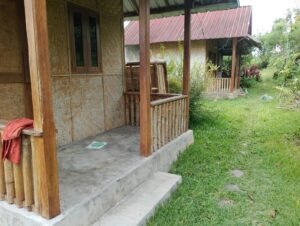
Tetebatu’s tourism assets are clustered along several local and district roads such as Jalan Raya Tetebatu, Jalan Pariwisata Kembang Kuning, Monkey Forest road, and the Perian–Jenggik Utara corridor, which connect homestays, rice terraces, waterfall access points, and eco-tourism sites within a roughly 5 km radius[4][5][9][10]. The presence of multiple mapped accommodation points along these roads—from Tetebatu Rice Terrace Homestay and Tetebatu Terrace Homestay to Sarang Walet and other eco-lodges—indicates a basic but functional road network sufficient for small vehicles, motorbikes, and tourism shuttles[4][5][9][10].
At the village level, infrastructure is primarily community-driven, with new and renovated homestays regularly appearing in national and international booking platforms, signaling incremental investment in utilities (electricity, water, and internet connectivity) to meet guest standards[2][3][5][9][10][11]. Most listed properties advertise features such as private parking, 24-hour front desks, Wi-Fi, and landscaped gardens, which implies at least moderate reliability of power and telecommunications but not yet the level of redundancy seen in more mature resort areas[2][3][5][11]. Major regional infrastructure—like Lombok International Airport and the main east–west arterial highways—lies outside the immediate 5 km radius but provides essential access, typically via a 1–1.5 hour road transfer from the airport to Tetebatu; investors should budget for private transfer services to bridge this last-mile gap.
There is currently no visible large-scale commercial centre or mall within the core Tetebatu tourism cluster; retail and F&B remain dominated by warungs, small restaurants, and homestay-based eateries attached to properties along the main roads[4][7][8]. This limits immediate walkable amenities but reinforces the area’s positioning as a quiet, slow-travel destination rather than a mass-market resort strip, which has implications for target customer segments and required on-site facilities in investment projects.
Investor Sentiment
Investor and developer sentiment in Tetebatu is broadly positive but still fragmented, reflecting its stage as a growing tourism village rather than a fully institutionalised market[1][2][9]. Recognition as a Desa Wisata Tetebatu by the national tourism ministry and inclusion of homestays in the official Jadesta registry signal government support and formalisation, which typically improves investor confidence around destination promotion and community-based tourism programs[9]. The continuous rise in homestay listings across international OTAs—Booking.com, Hostelworld, and curated travel blogs—suggests that local owners are actively investing in rooms, bungalows, and small guesthouses to capture expanding tourist flows[2][4][7][8][11][13][14].
On the demand side, double- to triple-digit percentage growth in visitor numbers between 2022 and 2025 indicates that occupancy and room-night demand have increased materially, likely outpacing the rate of new supply additions[1][6]. Data showing nearly 20,000 foreign homestay guests by October 2024, plus more than 21,000 overnight stays in 2025, point to a structurally rising base of foreign tourism demand with relatively limited high-quality lodging capacity[1][6]. This mismatch favors yield-focused investors but also raises pressure on local infrastructure and risk of overextension if supply suddenly scales without proper market analysis.
Recent transactions are mostly small-scale and non-transparent (family plots, incremental room additions), so there is limited public evidence of large-ticket land or resort trades in Tetebatu itself; investor conversations tend to revolve around converting agricultural land to eco-lodges, adding rooms to existing homestays, or building small clusters of view villas. Demand currently exceeds supply for professionally managed, well-branded accommodation with consistent standards, while supply is abundant in basic homestays, creating an opportunity gap for mid-range and upper-mid-range products. Overall sentiment among local operators and visiting investors can be characterised as cautiously optimistic: strong belief in Tetebatu’s tourism trajectory but awareness that legal structuring, access, and market depth must be managed carefully.
Rental Demand
Short-term rental demand in Tetebatu is anchored by a dense ecosystem of homestays, guesthouses, and small bungalows listed on global platforms, including Booking.com, Hostelworld, and independent travel guides[2][4][7][8][11][13][14]. The diversity of listings—ranging from basic rooms to eco-style bungalows with gardens and terraces—indicates active demand for nightly stays from independent travellers and backpackers, reinforced by rapidly rising tourist arrivals since 2022[1][6]. Homestays commonly offer features such as private parking, on-site restaurants or bars, and tour coordination to nearby waterfalls and rice terraces, suggesting that many guests are staying multiple nights rather than only passing through[2][3][5][11].
Publicly visible pricing points show budget hostel and homestay beds starting from roughly €0.77–2.87 per night in 2026, which is extremely low by international standards and indicates a price-sensitive segment but also potentially high occupancy when combined with foreign visitor growth[8][13][14]. Given recorded volumes of around 19,206 foreign guests across Tetebatu homestays in the first nine months of 2024, approaching 20,000 by mid-October, and over 21,000 overnight stays in 2025, it is reasonable to infer that peak-season occupancy for popular properties is substantially above off-season levels and that many homestays are operating at or near capacity during the mid-year dry season[1][6].
Long-term rental demand is more niche but likely growing, driven by remote workers, volunteers, and slow travellers attracted to cooler climate and rural ambiance compared with coastal areas. With room rates starting below €3 per night in some hostels, owners can profitably pivot some inventory to monthly stays (e.g., basic rooms priced in a band that remains affordable to foreigners while outperforming agricultural returns), especially if they add strong Wi-Fi and workspace amenities[8][13]. Investors targeting higher-yield nightly rates can position boutique villas and upgraded bungalows above the budget segment while still undercutting coastal resort prices, using the strong foreign visitor base and limited premium supply as a demand anchor.
Price Benchmarks
Risk Factors
Entry Strategy
Developer Activity
Market Outlook
Powered by Lombok AI Intelligence Engine · Updated weekly