Last updated: June 2026
Disclaimer: This article is for informational purposes only and does not constitute legal, financial, or investment advice. Property investment involves risk. Consult a qualified Indonesian notaris or property lawyer before making any investment decisions. All yield figures are indicative and based on current market data — actual returns will vary.
Selong Belanak Real Estate: What the Pioneer Window Actually Looks Like
Selong Belanak real estate sits at a specific moment in the investment cycle that serious buyers recognise: demand is confirmed, supply hasn’t caught up, and prices still reflect the present rather than the trajectory. Every mature market in Southeast Asia was once here. Koh Samui. Seminyak. Canggu. The investors who moved early didn’t have perfect information — they had a reading of direction. South Lombok is being read that way right now.
The beaches stretching west and south of Kuta Lombok — Are Guling, Mawun, Tampah, and Selong Belanak — remain largely undeveloped by any international hospitality standard. No major resort brands have arrived. Infrastructure is improving but incomplete. The investors and entrepreneurs arriving here are not buying into a proven market. They are betting on the direction.
That is precisely what makes it interesting — and exactly what makes careful analysis essential.
This guide examines south Lombok’s investment landscape in 2026: what’s there now, how the land value model works differently than Bali, what the Selong Belanak opportunity specifically looks like, and the honest risks any investor needs to weigh.
Run your south Lombok numbers in the ROI calculator before you read further — it helps frame the data that follows.
Bali Has a 10-to-12-Year Head Start. That’s the Investment Thesis.
Any credible assessment of south Lombok starts with the Bali comparison — not to dismiss Bali, but to understand exactly what the opportunity gap looks like.
Bali’s real estate market is mature. Demand is proven, occupancy rates are documented, villa management is professionalized, and legal structures are battle-tested. For investors who want to buy into an established market with relatively predictable returns, Bali still delivers.
But Bali’s maturity comes with costs. Entry prices have risen sharply — comparable beachside land in Seminyak or Canggu is priced at levels that compress yield significantly. Overdevelopment in key areas has created saturation in rental supply, putting downward pressure on average nightly rates. And crucially, the architectural and commercial monoculture has set in: the same white Mediterranean villa look, the same beach club format, the same international brand footprint, repeated across neighborhood after neighborhood.
Lombok’s south coast, by contrast, is genuinely early. Visitor numbers to Lombok are growing — international arrivals are increasingly choosing to base their itinerary on Lombok rather than using Bali as their primary destination. But the physical supply of hospitality infrastructure hasn’t kept pace with this demand signal. That gap — between growing demand and limited supply — is the structural basis for the investment thesis.
The risk, of course, is timing. Bali’s 10-to-12-year head start is real. Lombok may continue to develop slowly, or unevenly, or with infrastructure delays that extend timelines. An investor needs to price in that illiquidity — more on that below.
The Three-Layer Land Value Model — How South Lombok Differs from Bali
One of the most practically useful things to understand about south Lombok’s land market is how value is distributed relative to the beach — and how differently it behaves compared to Bali.
In mature Bali beach areas, land value follows a steep exponential curve from the shoreline. Beachfront commands premium pricing. But move 100 to 200 metres inland, and without a view or direct beach access, values drop sharply. The logic: in a saturated market, what guests pay premium rates for is proximity.
In south Lombok’s underdeveloped coastal areas, the value gradient has a more complex shape — arguably more interesting for investors.
Tier 1 — Beachfront: Direct ocean access, full views, walking distance to the water. Premium pricing. Limited supply. This is where you’d expect the highest $/sqm today.
Tier 2 — The Flat Land Behind: South Lombok beaches are often bordered by flat lowland before the terrain rises. This land has different potential — it’s the natural footprint for beach clubs, social infrastructure, accommodation with beach proximity, and support facilities. In established Bali beach precincts, this land is already built out. In south Lombok, it’s largely empty. Investors looking at commercial development potential (rather than pure residential villa ROI) should pay close attention to this tier.
Tier 3 — Standalone Hillsides: Several south Lombok beaches — Tampah is the clearest example — are backed by hills that rise to significant elevation. Within those hills, standalone elevated parcels exist that offer 360° visibility: beach views, bay views, and ocean panoramas in multiple directions. In a developed market, these would command extraordinary premiums for boutique resort or luxury villa development. Today, land in this category remains accessible at prices that reflect the current, not the future, state of the area.
Understanding which tier you’re buying into matters enormously for your investment strategy. The beachfront is a long hold and appreciation play. The flat commercial land is an operational play if you intend to build. The hillside is a development play — highest upside potential, highest execution risk.
Are Guling and Mawun: Raw Potential, No Infrastructure
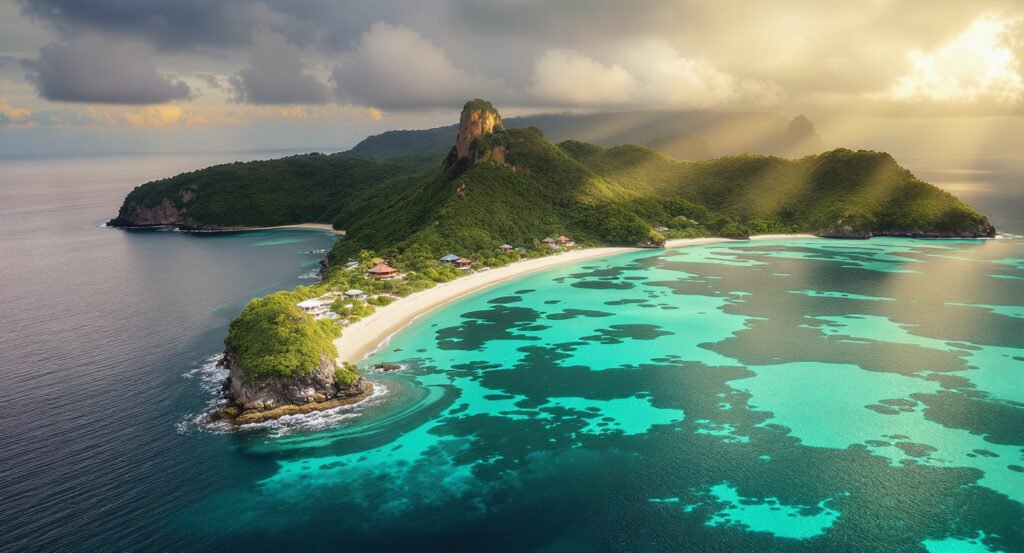
Are Guling and Mawun beaches sit to the immediate west of Kuta Lombok. Both offer spectacular coastal settings — the kind that satellite imagery and drone footage make look obviously investable.
The on-the-ground reality in 2026 is more honest: these areas are largely undeveloped. Social infrastructure is minimal. Access roads are improving but still basic. There are no operating hospitality businesses of significance. The beaches are essentially pristine and visitor numbers are low.
What that means for investors depends on your risk tolerance. For a long-horizon land hold — buy and hold, wait for the area to develop — the entry price case exists. Comparable undeveloped coastal land has appreciated significantly as south Lombok has been drawn into the Mandalika infrastructure orbit; land prices in the broader Mandalika corridor rose approximately 22% in 2024 alone.
But for yield-seeking investors expecting near-term rental income, these areas are not there yet. Building a revenue-generating asset in Are Guling or Mawun today means building the market before you build the property — a high-effort proposition that suits developers more than passive investors.
Land plots currently for sale in this corridor
Tampah Hills: Where the Architecture Is Already Setting the Standard
Tampah Beach presents a more nuanced picture — and arguably the most visually compelling investment case on the south coast.
The beach itself has seen limited development. A single quality beach bar operates on the shore, and commercial activity around it is sparse. In that sense, Tampah Beach appears stalled compared to where the development ambition seems to be.
But the hillsides rising above Tampah Beach tell a different story. Individual villa projects here have been built to a design standard that stands out sharply against the broader south Lombok context. The architectural diversity — round villas, cantilevered ocean-view structures, designs with genuine individual character — reflects a deliberate approach to quality that is notably different from the architectural monoculture that has taken hold in Bali’s more developed areas.
This matters for investors because the architectural identity of an area is hard to establish retroactively. Bali’s most saturated precincts now struggle with the white Mediterranean aesthetic being replicated at scale with no coordination or planning. Tampah Hills appears to be forming a different cultural foundation — one where individual design expression and quality are the norm rather than the exception.
Whether the rest of the area develops to meet the standard already set on the hillsides is the open question. The supply-side risk is real: if demand never arrives to activate the rest of the beach area, hillside villa yields will remain limited by the absence of adjacent hospitality infrastructure.
For investors: Tampah Hills is a speculative long hold with high upside if the beach precinct activates, and a longer-than-expected timeline risk if it doesn’t.
Beachfront and hillside plots for sale
Selong Belanak Real Estate: The Area Where Word Is Getting Out
Selong Belanak real estate receives more investor attention than any other south coast location outside Kuta — and based on the current state of the area, that attention is early rather than late. For a deeper location-specific breakdown, see the Selong Belanak property investment guide.
The beach is excellent by any standard: a long, curved bay with consistent surf, clean sand, and easy public access. Visitor numbers are growing. Unlike some south Lombok beaches, Selong Belanak has the beach quality to sustain genuine tourist demand — a fundamental requirement that is sometimes overlooked in frontier market analysis. Good investment land needs a reason for visitors to come. Selong Belanak has one.
Current state of development:
– Tourism activity exists but is partial: surfboard rentals, deckchairs, and basic food and beverage, concentrated in sections of the beach
– Large sections of the beach remain pristine and undeveloped
– The surrounding land is sparsely built, with a mix of local residential, empty plots, and early hospitality projects
– A hillside above the beach has existing structures — basic development that currently underutilises the elevation and view premium
What makes Selong Belanak distinct from Are Guling or early-stage Mawun is that the demand validation is already visible. The beach is drawing visitors. The question for property investors is: at what point in the demand curve does supply begin to follow?
The answer appears to be now. Selong Belanak is moving from “undiscovered” to “known but underdeveloped” — the specific phase where land acquisition ahead of supply growth tends to generate the strongest long-term returns.
Selong Belanak Real Estate Yields: What Data Is Available?
Selong Belanak real estate yield data is still limited — the area does not yet have a large enough pool of operating short-term rental properties to produce reliable aggregate benchmarks. This is itself a signal of how early the market is.
The closest proxy is south Lombok generally: operational eco-resort and boutique villa projects in this coastal strip have reported gross yields of 14–20%, driven by high nightly rates ($150–$300+ for well-positioned properties), lower entry costs than Kuta, and constrained competitive supply. That supply constraint won’t last indefinitely. But for projects entering the market now, it represents a significant yield window.
Use the Lombok Investment Calculator to model a Selong Belanak villa scenario with your target entry price and expected occupancy rate. Even at conservative assumptions, the numbers can be compelling.
Land plots currently for sale in the Selong Belanak area
No Brands, No Competition — The Entrepreneur Window
One of the most commercially significant observations about south Lombok in 2026 is the complete absence of mid-sized or large international hospitality brands from the south coastal strip.
This is unusual by regional standards. In comparable early-stage beach markets across Southeast Asia, international brands tend to arrive within 3-5 years of the first significant infrastructure investment signal. The Mandalika SEZ — which has attracted Hyatt, is drawing further luxury resort development, and sits within the broader south Lombok tourism zone — provides exactly that signal.
What this means in practice: the hospitality and accommodation market in areas like Selong Belanak, Tampah, and the broader south coast is currently served entirely by independent, grassroots operators. (For comparison, see how Kuta Lombok has progressed one step further along this curve — it offers a useful preview of the trajectory for these surrounding areas.) Beach bars, surf camps, small guesthouses, individual villa rentals. No Marriott Bonvoy points, no IHG loyalty program, no Airbnb Plus management chains.
For entrepreneurs building an accommodation or hospitality concept, this is the highest-margin window available. No brand competition compresses pricing. No comparable supply creates a ceiling on nightly rates. The first well-executed boutique property in an area captures demand that has no other premium outlet.
The entry barrier is exactly what one might expect from such an opportunity: you are building in a frontier market, which means execution risk, infrastructure gaps, and a visitor base that is still self-selecting toward adventurous rather than mainstream travelers. The returns, for those who execute well, reflect that risk premium.
Land vs Villa in South Lombok: What the Investor Actually Buys
South Lombok’s investment market roughly divides into two buyer types:
Land hold investors — acquisition of undeveloped land with the intention of holding for capital appreciation, either selling to a developer or building later once the market matures. This strategy requires long time horizons (5–10 years minimum), patience through illiquid periods, and comfort with the specific risks of land title in Lombok’s still-developing registry environment. The upside can be significant: investors who took land positions in areas that later became part of the Mandalika development corridor have seen substantial appreciation.
Villa development investors — acquisition of land for construction of a short-term rental villa or boutique property, with the intent to generate yield from Day 1 of operation. This requires a larger total capital commitment (land + construction + management), but produces income during the hold period. Well-positioned villas in south Lombok with quality fit-out and professional management are currently targeting 14–18% gross yield, with the yield premium justified precisely by the constrained supply.
There is no universally correct answer between these strategies. But the choice should be made consciously, with eyes open to what each requires.
A third path worth noting: some investors have acquired larger undeveloped parcels — not beachfront individual plots, but multi-hectare land banks on the southern coast — with the explicit intention of holding through the development cycle. One real estate transaction pattern emerging from south Lombok’s investment story is experienced Bali-market investors choosing a significant land position in south Lombok over a single villa purchase in Bali. The logic: lower entry price, higher appreciation potential, and land that is unlikely to depreciate if the south coast develops as projected.
Honest Risk Assessment
Any south Lombok investment guide that doesn’t spend time on risk is not a guide — it’s a brochure.
Infrastructure timeline risk: Road access to several south coast beaches has improved but remains incomplete. Development of the beachfront social infrastructure that makes premium rental pricing sustainable depends on continued investment. Delays are common. Budget for slower-than-expected timelines in any financial model.
Liquidity risk: There is no liquid resale market for property in most south Lombok locations. If you need to exit quickly, you may not find a buyer quickly. South Lombok land and villa investment is a multi-year commitment. Do not invest capital you need access to in under 5 years.
Land title complexity: Lombok’s land registry has historical inconsistencies. Before any purchase, independent title verification through a reputable notaris is non-negotiable. Girik (letter C) land in particular requires full conversion to an SHM title — do not close without this step complete.
Demand validation risk: Some south coast areas (Are Guling, Mawun) have limited visitor numbers today. The assumption that visitor demand will grow to justify premium build-out is exactly that — an assumption. Verify current visitor trends, look at Lombok tourism data, and stress-test your occupancy projections against pessimistic scenarios.
Foreign ownership structure: As a foreign investor, you cannot hold freehold land (Hak Milik) in Indonesia. Your options are leasehold (Hak Sewa, typically 25–30 years extendable) or a PT PMA (Perseroan Terbatas Penanaman Modal Asing) company structure. Each has cost, tax, and control implications. See our full Bali vs Lombok comparison and rental yield guide for the numbers context — and consult an Indonesian property lawyer for your specific structure.
Due Diligence Checklist for South Lombok Land and Villa Investment
Before committing to any south coast acquisition:
- [ ] Title verification: Confirm SHM (Sertifikat Hak Milik) or verify conversion path from Girik/Letter C through a licensed notaris
- [ ] Zoning confirmation: Check with local Badan Pertanahan Nasional (BPN) office that the land is zoned for intended use (tourism/commercial vs agricultural)
- [ ] Access rights: Verify legal road access to the plot — some parcels in south Lombok have only informal/track access, not legally registered road frontage
- [ ] BPHTB and PPH: Budget for land and building acquisition duty (BPHTB, typically 5% of transaction value) and income tax on seller proceeds (PPH, 2.5%)
- [ ] PT PMA structure: Confirm minimum paid-up capital requirements and engage a reputable legal firm for structure setup before purchase
- [ ] Notaris selection: Use a notaris independent of the seller — do not use the seller’s recommended notaris
- [ ] Topography and utilities: Assess slope, drainage, and access to electricity, water, and internet before construction feasibility
Conclusion
South Lombok’s coastal investment story is not about certainty. It is about positioning ahead of a transition that the evidence suggests is underway: growing visitor arrivals, improving infrastructure, a small but growing community of international entrepreneurs who have chosen to build here, and land prices that still reflect the present rather than the future.
Selong Belanak specifically offers a combination rarely available in one location: genuine beach quality to sustain demand, existing but early visitor activity, and land supply that has not yet repriced for what the area is likely to become. That combination has historically been the signal for patient investors.
The analysis has to be done carefully. Title verification is non-negotiable. Yield projections need to be stress-tested. Foreign ownership structures need legal advice, not assumptions. The timeline needs to be long.
But for investors who have done the work and have the time horizon, south Lombok’s undiscovered coast is worth the trip.
Model your Selong Belanak or south Lombok investment in the free ROI calculator →
Download the complete Lombok investor guide (PDF) →
Last updated: June 2026. Land prices and yield figures are indicative based on current market data. Exchange rates fluctuate — use the calculator to model in your home currency. Check BKPM/OSS for current foreign investment regulations.

Author: Brusca
Living in Indonesia for 15 years, with hands-on experience in how the Indonesian real estate industry actually works. Lombok is currently the fastest-growing property market in Southeast Asia. Every listing on this site is vetted where timing allows.







Leave a Reply