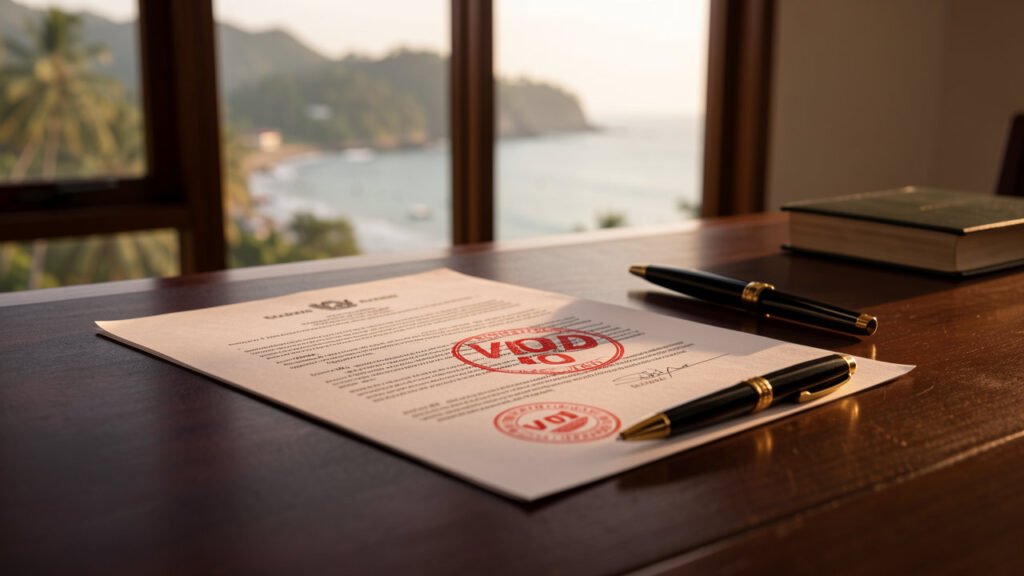
Foreign buyers in Indonesia hear about a nominee agreement Indonesia setup all the time. Put the land in an Indonesian friend’s, spouse’s, or staff member’s name, and you still “own” it. It sounds like a shortcut. It is a void transaction with no legal standing, and the risk sits entirely on the foreign buyer.
Indonesian law is explicit. The arrangement is void from the moment it is signed, no matter what side agreements, loan documents, or powers of attorney sit beside it.
Watch the video walkthrough above, or read our guide on PT PMA vs Hak Pakai for the legal structures that actually work.
What a Nominee Arrangement Actually Is
A nominee arrangement is when a foreigner funds the purchase of land or property, but the certificate is registered in the name of an Indonesian citizen. That person might be a friend, a spouse, a staff member, sometimes a lawyer or notary. They hold it “on behalf of” the foreign buyer.
There is usually a side agreement: a loan document that frames the purchase money as a loan to the nominee, a power of attorney, sometimes a right-of-first-refusal or option-to-purchase contract. Those papers are meant to give the foreign buyer some form of control or recourse.
None of that changes the legal reality. Indonesian courts do not look at what the paperwork is called. They look at what it is actually for. If the substance is a foreigner acquiring land ownership through an Indonesian proxy, courts treat it as exactly that, and it is void.
The Legal Basis
This sits in statute, and the Supreme Court has reinforced it.
Basic Agrarian Law (UUPA), Law No. 5 of 1960:
- Article 21(1) reserves freehold land ownership (Hak Milik) to Indonesian citizens only.
- Article 26(2) states that any transaction intended to transfer freehold land to a foreigner, directly or indirectly, is null and void by law. The land falls to the State, and payments already made cannot be reclaimed.
For further reading on how Indonesian courts and practitioners treat these structures, see Hukumonline on nominee agreements and Hukumonline on PMA land ownership.
Investment Law, Law No. 25 of 2007 covers the equivalent scheme for company shares, where foreigners use an Indonesian nominee shareholder to control a company:
- Article 33(1) prohibits any agreement where share ownership is held “for and on behalf of another person.”
- Article 33(2) declares such arrangements void by law.
Supreme Court Circular Letter (SEMA) No. 10 of 2020 instructs Indonesian courts that they are obliged to declare nominee agreements null and void when the substance of the arrangement is identified, regardless of how the contract is drafted or labeled.
Presidential Regulation No. 13 of 2018 on Beneficial Ownership adds a modern compliance layer. Companies and asset structures now have to disclose their true beneficial owner, which makes a nominee structure harder to hide than it was a decade ago.
Taken together: a law written to close this exact workaround, a Supreme Court directive telling judges to enforce that closure without exception, and a newer disclosure regime that makes concealment harder. Careful paperwork does not change the outcome.
Is a nominee agreement legal in Indonesia? No. The statutes above leave no compliant version of this structure.
Why Foreigners Use Them Anyway
The appeal is straightforward. A nominee arrangement is fast. It does not require setting up a PT PMA or negotiating a formal lease, and on paper it looks like real ownership. Someone recommends a trusted local contact. A lawyer drafts a loan agreement and power of attorney to “protect” the buyer. It feels solved.
What it does not do is create any enforceable legal right. Every protection built into the side agreements (the loan document, the power of attorney, the option contract) is unenforceable for the same reason the underlying arrangement is void. An Indonesian court will not enforce a contract whose real purpose is to circumvent a law it exists to enforce. If a dispute reaches a courtroom, those side agreements do not help. They become evidence of the arrangement the law prohibits.
Four Ways These Arrangements Actually Fail
These are ordinary, foreseeable ways a nominee arrangement for land in Indonesia falls apart. Legal commentary on this structure documents them consistently.
1. The nominee dies. The land is legally theirs, so it passes to their heirs under inheritance law, not to the foreign buyer who funded it. The foreign buyer has no registered interest in the asset and no standing to claim it back from the estate.
2. The nominee divorces. If the nominee is married under Indonesian marital property rules, the land can become part of the marital estate subject to division. Again, the foreign buyer holds no registered claim.
3. The nominee’s creditors come after it. Because the certificate is in the nominee’s name, it is a legitimate target for anyone the nominee owes money to. A debt that has nothing to do with the foreign buyer can result in the land being seized to satisfy it.
4. The nominee simply refuses. The registered owner can refuse to transfer, refuse to sell, or sell to someone else entirely. Because the underlying arrangement is void, the foreign buyer has no enforceable claim to stop them or recover their money.
In every one of these four scenarios, the foreign buyer’s only “protection” (the loan agreement, the power of attorney) is the same unenforceable paperwork described above. There is no court remedy waiting at the end of any of these situations.
“Everyone Does It” Isn’t Protection
Nominee arrangements are common in Indonesia. Common enough that frequency is easy to mistake for safety. A structure being widespread does not change its legal status. Courts have shown no reluctance to void these agreements when they are identified, precisely because SEMA No. 10 of 2020 instructs them to.
What “it is common” usually means: a lot of people are carrying a risk they do not fully understand, and most of them will never have a reason to test it in court, right up until the nominee dies, divorces, runs into debt, or simply decides to keep the land. Popularity does not make the arrangement safer. For most people who use it, the arrangement is simply untested, until it isn’t.
The Legal Alternatives
None of this means a foreigner cannot build a position in Lombok real estate. It means the legal routes require more structure than a nominee arrangement, in exchange for actually being enforceable.
Frequently Asked Questions
Is a nominee arrangement ever legal if it is drafted carefully enough?
No. Indonesian courts look at the substance of the arrangement, not the labels used in the paperwork. A loan agreement or power of attorney designed to give a foreign buyer effective control over land held by an Indonesian nominee does not change the legal outcome. SEMA No. 10 of 2020 directs courts to void the arrangement regardless of how it is drafted.
What happens to the money already paid if a nominee arrangement is voided?
Under Article 26(2) of the UUPA, payments already made cannot be reclaimed. The land falls to the State, and the foreign buyer has no court remedy to recover the purchase price.
Does this apply to using a spouse as the nominee?
Yes, if the underlying purpose is circumventing the foreign ownership restriction. Marriage to an Indonesian citizen does not itself create a legal path to foreign land ownership. The correct structures (PT PMA, Hak Sewa, Hak Pakai) still apply regardless of marital status.
Ready to structure a purchase the legal way? Use the Lombok ROI Calculator to model returns once you have settled on the right ownership structure, or download the free investor guide for the complete buying process.
For related reading, see PT PMA vs Hak Pakai: Which Structure is Right for You?, Indonesia Land Certificate Types: Complete Guide for Foreign Investors, and The 4 Due Diligence Checks Before Buying Land in Lombok.
Disclaimer: This article is for informational purposes only and does not constitute legal, financial, or investment advice. Property investment involves risk, including the potential loss of capital. Nominee arrangements described in this article are void under Indonesian law; consult a licensed Indonesian notaris or property lawyer before structuring any property purchase. All information is indicative and based on current legislation as of September 2026, including UUPA Law No. 5 of 1960, Investment Law No. 25 of 2007, SEMA No. 10 of 2020, and Presidential Regulation No. 13 of 2018; verify current requirements independently, as regulations may change.
Is this the same law that applies to company shares, not just land?
It is a parallel prohibition under a different law. Land nominee arrangements fall under UUPA Article 26(2). Nominee shareholder arrangements for controlling a company fall under Investment Law Article 33. Both are declared void by law, for the same underlying reason.
The Bottom Line
A nominee agreement Indonesia buyers are offered as a “workaround” is void from the moment it is signed. That follows from a law written to close this exact route, and from a Supreme Court circular telling judges to enforce that closure without exception. If the nominee dies, divorces, runs into debt, or simply refuses to cooperate, there is no court remedy on the other side.
The legitimate alternatives (PT PMA with HGB title, Hak Sewa leasehold, or Hak Pakai in your own name) take more setup. They put a real, registered, enforceable legal interest in your name instead of an informal understanding with someone else’s name on the certificate.

Author: Brusca
Living in Indonesia for 15 years, with hands-on experience in how the Indonesian real estate industry actually works. Lombok is currently the fastest-growing property market in Southeast Asia. Every listing on this site is vetted where timing allows.







Leave a Reply