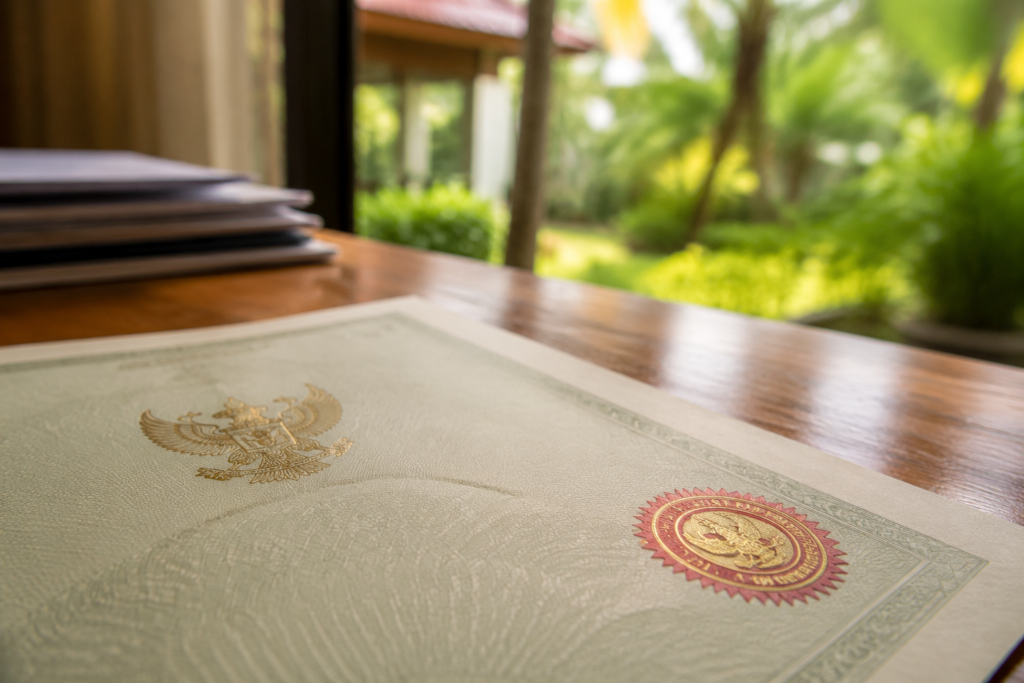
Most foreign investors researching Lombok run into the same wall in regards to indonesia land certificate types within their first week: every listing, every agent conversation, every legal disclaimer mentions a different certificate — SHM, HGB, Hak Pakai, Hak Sewa — and nobody explains which ones you can actually hold as a foreigner, and which ones will quietly disqualify you from ever legally owning what you paid for.
There are nine distinct land right categories under Indonesian law. Only a handful are relevant to a foreign buyer, but understanding all nine matters — because sellers, agents, and even some notaries will use the terms loosely, and the difference between “HGB” and “Girik” on a piece of paper is the difference between a legitimate investment and a legal dead end.
This guide breaks down all nine certificate types, what each one actually grants, who can legally hold it, and — most importantly — the three practical routes that cover almost every foreign investor buying in Lombok today.
Use the Lombok ROI Calculator to model returns once you’ve confirmed which certificate structure fits your purchase.
SHM — Sertifikat Hak Milik (Freehold Title)
SHM is the strongest form of land ownership recognized under Indonesian law — full freehold, held indefinitely with no expiry date, and freely inheritable, giftable, and transferable.
It’s also the one certificate type foreigners cannot hold, under any structure. SHM is reserved exclusively for Indonesian citizens (WNI) and certain Indonesian legal entities. This isn’t a formality that can be worked around — nominee arrangements, where a foreigner has an Indonesian citizen hold SHM “on their behalf” through a private side agreement, are illegal and unenforceable in Indonesian courts. If the nominee dies, changes their mind, or has a dispute with their own family, the foreign investor has no legal claim to the land, regardless of what was signed privately.
If you see SHM land marketed to foreigners as a direct purchase, that’s the first red flag in the entire transaction.
HGB — Sertifikat Hak Guna Bangunan (Right to Build)
HGB grants the right to construct and own buildings on the land it covers, for an initial period of 30 years, renewable for a further 20 years, and — under PP 18/2021 — extendable for another 30 years after that, for up to 80 years of continuous rights.
HGB is available to Indonesian citizens, Indonesian legal entities, and PT PMA companies — foreign-owned limited liability companies. This makes it the primary vehicle for serious foreign investment in Lombok: set up a PT PMA, and the company holds HGB title with full commercial development rights. It’s the most common certificate type behind villa developments, hotels, and commercial tourism projects across the island, and Indonesian citizens holding HGB can later upgrade it to SHM.
HGU — Sertifikat Hak Guna Usaha (Right to Cultivate)
HGU is a specialized right for agricultural, plantation, fishery, or livestock use — not residential or tourism development. It runs for an initial 35 years, renewable for 25 years, and extendable for a further 35 years under the current framework.
Like HGB, it’s available to Indonesian citizens and Indonesian legal entities including PT PMA — but it comes with a minimum land size requirement of 5 hectares, and it sits on state land rather than privately-held land. Unless you’re structuring a large-scale agricultural investment (a working plantation, aquaculture operation, or similar), HGU generally isn’t the certificate type you’re looking for in Lombok.
Hak Pakai — Sertifikat Hak Pakai (Right of Use)
Hak Pakai is the only land title foreigners can hold directly in their own personal name in Indonesia. It comes in two forms: Hak Pakai on state land (30 years, extendable 20, renewable 30 — the same 80-year total structure as HGB), and Hak Pakai granted over privately-held SHM land by a PPAT deed, which runs up to 30 years and is renewed by a new deed with the owner (PP 18/2021 Art. 52).
Under PP 18/2021 (which replaced PP 103/2015), a foreigner holding a valid immigration document can apply for Hak Pakai — the regulation’s elucidation defines this as a visa, passport or stay permit, so a KITAS or KITAP is not the only route, though it’s worth confirming with your notaris what the local land office accepts in practice. Use is strictly residential, not commercial tourism development, and generally limited to one plot of up to 2,000 m² per person or family. There’s also a minimum property price that varies by region: under Kepmen ATR/BPN 1241/SK-HK.02/IX/2022, in Lombok (NTB province) it is Rp 3 billion for a landed house (rumah tapak) and Rp 1 billion for an apartment. Below that price, a foreigner cannot hold Hak Pakai on the property directly.
For an investor planning a rental villa or commercial project, Hak Pakai’s residential-only restriction usually rules it out — it’s built for someone who wants a personal home in Lombok, not a business.
Hak Sewa — Leasehold
Hak Sewa isn’t a certificate of ownership at all — it’s a contractual right to use land, leased directly from an SHM holder for an agreed term. In Lombok, typical terms run 25 to 30 years with an option to extend.
A lease doesn’t create a registered title, so your position rests mainly on the strength of the lease contract itself. Under PP 18/2021 Article 90, you can apply to the BPN land office (the national land agency) to have a lease over registered land recorded in the land register and on the SHM certificate, which puts later buyers and banks on notice. That recording is optional and doesn’t turn the lease into a title. That makes notarization by a PPAT (a licensed land-deed notary) essential — the agreement needs to clearly define extension rights, rental terms, and exit clauses, because the contract, not a certificate, is what protects you if a dispute arises. One risk worth naming plainly: if the landowner dies, their heirs aren’t automatically bound by the lease terms the original owner agreed to, which can create real complications mid-term.
Despite that risk, Hak Sewa is the most common structure foreign investors actually use for villa and hospitality development in Lombok — lower entry cost, faster to execute, and no PT PMA setup required.
HPL — Hak Pengelolaan (Management Rights)
HPL is held exclusively by government bodies and state-owned enterprises (BUMN) — it’s not something a private investor, foreign or Indonesian, can hold directly. What it controls is large tracts of state land, on top of which private investors can then be granted HGB or Hak Pakai.
This matters specifically if you’re looking at land inside the Mandalika Special Economic Zone — the underlying land there is largely HPL, held by ITDC (Indonesia Tourism Development Corporation). Any private development inside the kawasan sits on an HGB or Hak Pakai layered on top of that HPL, not on freestanding freehold.
Girik / Letter C / Petok D — Legacy Tax Records
Girik (also called Letter C or Petok D depending on the region) is not a land certificate at all — it’s a colonial-era tax record, proof that someone paid land tax on a parcel, not proof of legal ownership under modern Indonesian law.
Under PP 18/2021, landholders had a five-year window to convert these legacy documents into a formal BPN-issued certificate. That conversion deadline was February 2, 2026 — it has now passed. As of that date, Girik and similar customary tax records no longer count as standalone proof of ownership. They can still support a registration or ownership claim as supporting evidence (“petunjuk”) — alongside witnesses, physical occupation history, and boundary records — but they can no longer stand alone in a dispute or a first-time registration.
Girik land is still common in rural parts of Lombok, and it’s still sometimes sold as if it were a proper title. Buying Girik land that hasn’t gone through formal conversion is now higher risk than it was before the deadline, not lower — treat any Girik-only listing with real caution, and don’t proceed without a notaris confirming the current registration status.
Hak Ulayat — Customary Community Land
Hak Ulayat is communal land held collectively under traditional adat (customary) law, belonging to an indigenous community rather than any individual. It can’t be individually owned or freely transferred, and it sometimes overlaps with land that also carries a formal certificate — a source of serious, sometimes years-long disputes.
Hak Ulayat is more common in remote and agricultural areas of Lombok. If you’re looking at land in a less-developed area, it’s worth checking directly with the Kepala Desa (village head) and local community leaders before any transaction — community consensus is required before development can legally proceed, formal certificate or not.
Strata Title — HMSRS (Hak Milik atas Satuan Rumah Susun)
HMSRS is ownership of an individual unit within a multi-story building — apartments and condominiums, not landed property or land itself. Under PP 18/2021, it’s the closest thing to freehold-equivalent title a foreigner can hold in Indonesia, but it’s narrowly scoped: the building must be designated Rumah Susun Komersial, generally located within a special economic zone, free trade zone, industrial zone, or a designated tourism, suburban, or urban economic zone. Foreign-owned units are also capped at a maximum of 49% of a building’s total floor area.
Minimum value thresholds apply here too, varying by province. HMSRS isn’t relevant to land investment — but if a condo or apartment project is part of your Lombok plans, it’s the only structure that gets you a personal-name title rather than a lease.
Indonesia Land Certificate Types — Quick Reference
| Certificate | Who Can Hold | Duration | Development Use |
|---|---|---|---|
| SHM | Indonesian citizens only | Permanent | Any |
| HGB | Indonesian citizens + PT PMA | 30+20+30 years | Commercial / tourism |
| HGU | Indonesian citizens + PT PMA | 35+25+35 years | Agriculture only (min. 5 ha) |
| Hak Pakai | Foreigners (personal, valid immigration document required; NTB minimum Rp 3 billion landed house / Rp 1 billion apartment) | 30+20+30 years over state/HPL land; 30 years over SHM, renewable by deed | Residential only |
| Hak Sewa | Foreigners (contractual leasehold) | Negotiated | Any, per contract |
| HPL | Government / BUMN only | Permanent | State-managed |
| Girik / Letter C | Transitional only — must convert | Conversion deadline passed Feb 2026 | None until converted |
| Hak Ulayat | Community only | Communal | Community-controlled |
| Strata Title (HMSRS) | Foreigners (unit ownership) | Permanent | Apartment/condo units only |
For Lombok Investors — The Practical Reality
Nine certificate types exist on paper. In practice, almost every foreign investor buying in Lombok ends up choosing between three routes.
Option A — PT PMA + HGB
Set up a foreign-owned Indonesian company (PT PMA), and the company holds HGB title on the land. This gives full commercial development rights — the route to take if you’re building villas, a small hotel, or any project you intend to operate as a business. It’s the most involved option to set up, but it’s also the only one of the three built for serious, scaled commercial development. See our full breakdown in PT PMA vs Hak Pakai for the setup process and cost comparison.

Option B — Hak Sewa (Leasehold)
Lease the land directly from the SHM holder. Lower entry cost, faster to execute, no company formation required. This is the most common structure for foreign investors building a villa or small hospitality project — and a sensible way to test a specific location or business idea before committing to the cost and complexity of a PT PMA. The trade-off is that your protection is only as strong as the lease contract itself, so a PPAT-notarized agreement with clearly defined terms isn’t optional.

Option C — Hak Pakai (Personal Name)
Hold the title directly in your own name, but strictly for residential use — this is not a route to commercial development. It requires a valid immigration document (a visa, passport or stay permit under PP 18/2021), and in Lombok (NTB), a landed house has to clear a minimum price of Rp 3 billion (Rp 1 billion for an apartment). Of the three, this is the least common for investment purposes specifically because of the residential-only restriction — it fits someone building a personal home in Lombok more than someone building a rental portfolio.
Before committing to any of the three, confirm exactly what certificate the land currently holds — see our companion guide, The 4 Due Diligence Checks Before Buying Land in Lombok, for how to verify a title at the BPN office before you sign anything.
Frequently Asked Questions
Can a foreigner ever hold SHM freehold title in Indonesia? No, not directly and not through a nominee arrangement. SHM is reserved for Indonesian citizens and certain Indonesian legal entities under Indonesian law, and nominee structures attempting to work around this are illegal and unenforceable.
What’s the most common certificate type for foreign investors in Lombok? Hak Sewa (leasehold) and HGB via a PT PMA are the two most common routes, covering the majority of foreign-backed villa and hospitality development on the island.
Is Girik land still safe to buy in 2026? It carries meaningfully more legal risk now that the PP 18/2021 conversion deadline (February 2, 2026) has passed. Girik and similar legacy documents can no longer stand alone as proof of ownership — always confirm current registration status with a notaris before proceeding.
Do I need a PT PMA to buy land in Lombok? No. A PT PMA is required specifically for HGB title if you’re pursuing commercial development. Hak Sewa (leasehold) and Hak Pakai (residential, personal name) don’t require a company structure.
The Bottom Line
Nine certificate types exist under Indonesian land law, but only three routes matter for the overwhelming majority of foreign investors in Lombok: a PT PMA holding HGB for commercial development, a notarized Hak Sewa lease for a faster and lower-cost entry, or Hak Pakai in your own name for a residential purchase. Everything else on this list — SHM, HGU, HPL, Girik, Hak Ulayat, HMSRS — matters mainly for recognizing what you can’t legally hold, and for spotting a red flag before you’re financially committed.
Ready to model returns on a specific property? Try the Lombok ROI Calculator, or download the free investor guide for a full walkthrough of buying safely in Lombok as a foreigner.
Disclaimer: This article is for informational purposes only and does not constitute legal, financial, or investment advice. Property investment involves risk, including the potential loss of capital. Regulations and market conditions change — verify all legal requirements with a qualified Indonesian notaris or property lawyer before making any investment decisions. All figures are indicative and based on current market data; actual thresholds and terms will vary and should be confirmed at time of purchase.

Author: Brusca
Living in Indonesia for 15 years, with hands-on experience in how the Indonesian real estate industry actually works. Lombok is currently the fastest-growing property market in Southeast Asia. Every listing on this site is vetted where timing allows.




Leave a Reply