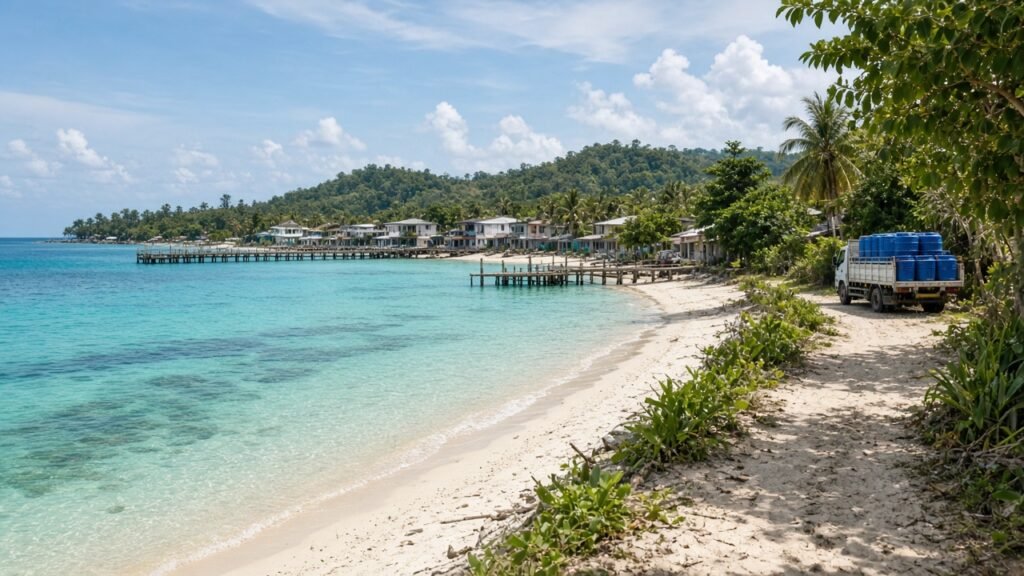
If you hold or underwrite rental property on Gili Trawangan, treat the early-September 2026 water stoppage as a utility and regulatory risk event that already cut occupancy, not as a one-off ops glitch. This brief sticks to reported facts from Detik Bali, InsideLombok, and Pemkab or Pemprov coverage via IDN Times NTB and NTBSatu, then maps what those facts mean for yields.
What Stopped the Taps
Around 3 to 4 September 2026, PT Tiara Cipta Nirwana (TCN), the seawater reverse osmosis (SWRO) desalination partner working with PDAM Amerta Dayan Gunung, halted clean-water supply to Gili Trawangan. Local reporting ties the stoppage to unfinished central-government permitting for seawater-to-freshwater processing. The bottleneck sits where marine-space and conservation rules meet ministry sign-off, with Kementerian Kelautan dan Perikanan (KKP) and related environmental or marine-conservation requirements (including LH-linked controls) still incomplete. TCN had already shown reluctance to keep taps open while paperwork remained open, citing legal exposure if it operated without a clean permit stack.
This is not a failure of desalination technology on the island. Officials have said the SWRO process itself is workable. The break is administrative and jurisdictional: unfinished central permits and local urgency to keep water flowing do not yet line up.
Hotel and Tourism Impact Already Counted
The Gili hotel association has put hard numbers on the first week of disruption.
- At least 315 early tourist departures were reported as guests checked out early when water failed (Detik, 6 September 2026).
- Hotels bought tanker water from the mainland and mixed limited clean water with brackish traditional wells.
- Operators stopped taking new bookings while supply stayed uncertain.
- At least five hotels were threatened with temporary closure (InsideLombok, 8 to 9 September 2026).
High season made the hit worse. Guest volumes on the Gili corridor were already high when the pipes went dry.
For investors, early check-outs and blocked new bookings are immediate occupancy damage. Contingency water at tanker rates is an operating-cost spike that short-stay margins do not absorb cleanly.
What Pemkab and Pemprov Did Next
On 7 September 2026, after a Forkopimda NTB meeting, Bupati Lombok Utara Najmul Akhyar issued a six-month operational discretion for TCN. The intent is temporary legal cover so TCN can reopen distribution while central permits at KKP and other ministries are finished. Pemkab and Pemprov framed the discretion as the fast option. Standing up a new operator would take longer than the island can wait.
In parallel, PDAM Amerta Dayan Gunung has been running emergency distribution of about 60 to 70 m³ per day for roughly 600 household heads (KK) on Gili Trawangan. That volume is sized for basic residential and public need. It is not a full replacement for hotel and tourism demand at high occupancy. Officials have also pushed for closer KKP accompaniment on the permit path so the island does not keep cycling through temporary discretion.
Status as of 9 September 2026
As of 9 September 2026, full restoration was not confirmed. Reporting from Detik Bali and related provincial coverage shows TCN still hesitant to reopen the main taps because of lingering legal risk even after the six-month discretion. Pemprov NTB continued to ask KKP to sit with TCN and PDAM on the permit file. Field checks and legal compilation at the provincial level were still underway. Emergency PDAM dropping continued. Main SWRO distribution had not been declared back to normal.
Investors should treat “discretion granted” and “water flowing at hotel scale” as separate facts until operators and Pemkab confirm continuous main-line supply.
Investor Angle: Yields, Occupancy, and Contingency
Gili islands property investment and Lombok rental yield assumptions matter here. Gili Trawangan rental yields depend on nights sold and guest experience. A multi-day clean-water outage hits both. Early departures, refunds, and paused bookings compress occupancy in the same week operators pay more for tanker water. That is utility risk and regulatory risk in one event. The supply chain sits on a single SWRO partner whose right to operate can be paused when central marine-conservation and permitting files lag.
Possible temporary demand spillover toward Senggigi and mainland North Lombok is a rational guest response when Gili stays cannot guarantee showers and toilets. That spillover can cushion mainland inventory in the short term. It does not protect a Gili villa or hotel that cannot deliver water. Do not model Gili ADR on brochure high season alone. Model a water contingency line: tanker or barge cost, well backup quality, reserve tanks, and how many days of guest ops those reserves cover.
Underwriting checklist for Gili rental assets after this event:
- Confirm whether the asset sits on PDAM or TCN main supply versus private wells or tanks.
- Price a 7 to 14 day tanker contingency into opex scenarios for high season.
- Ask operators for written protocols on early check-out, refunds, and booking freezes when water fails.
- Track permit status for TCN or any successor SWRO partner at KKP and related ministries. Temporary district discretion is not the same as a finished central permit.
- Compare Gili yield assumptions against Senggigi and mainland North Lombok inventory that is less exposed to island desalination permitting.
Foreign buyers who underwrite Gili on tourism growth alone miss the binding constraint. On a small island, water permitting is infrastructure. When that infrastructure pauses, occupancy pauses with it.
Sources
- Detik Bali coverage of the TCN halt, tourist early departures, Pemprov calls for KKP accompaniment, and PDAM emergency volumes
- InsideLombok reporting on hotel association impacts, tanker and brackish-well workarounds, booking freezes, and hotels threatened with closure
- Pemkab Lombok Utara and Pemprov NTB positions as reported via IDN Times NTB and NTBSatu, including the 7 September 2026 Forkopimda six-month discretion and the ~60-70 m³/day emergency supply for ~600 KK
FAQ
What caused the Gili Trawangan water crisis in September 2026?
PT Tiara Cipta Nirwana (TCN) halted its SWRO supply around 3 to 4 September 2026 while central permitting for seawater processing remained unfinished, overlapping marine-conservation and ministry requirements involving KKP and related environmental controls.
How did hotels and tourists respond?
At least 315 early tourist departures. Hotels bought tanker water, mixed brackish well water, stopped new bookings, and at least five hotels were threatened with temporary closure.
Has water supply been fully restored?
As of 9 September 2026, no. Pemkab Lombok Utara granted TCN a six-month operational discretion after the 7 September Forkopimda meeting, and PDAM ran emergency supply of about 60 to 70 m³ per day for roughly 600 KK, but TCN remained hesitant to reopen main taps over legal risk.






Leave a Reply