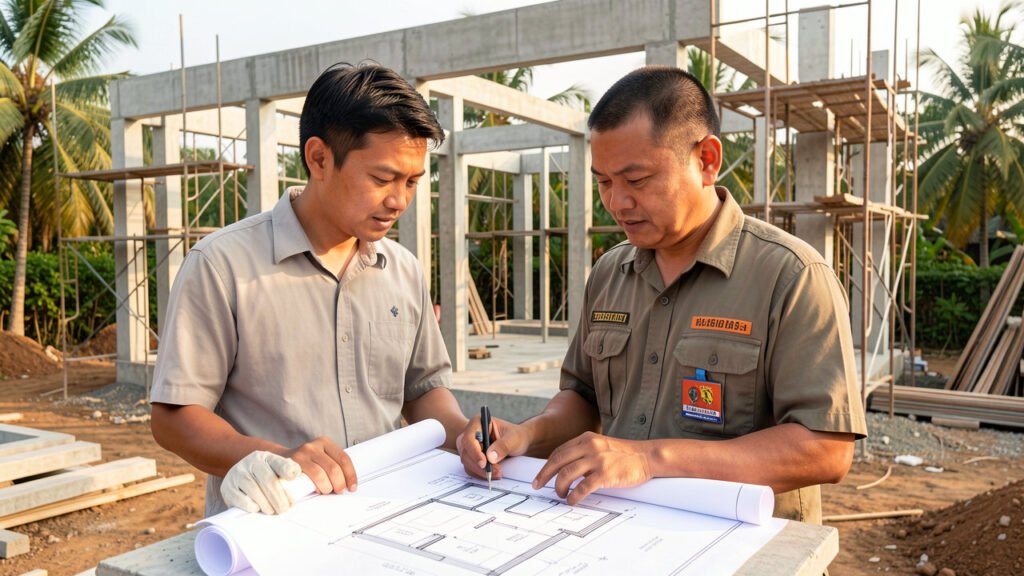
Before you sign anyone, run this Lombok contractor checklist first. Ask any notaris or project supervisor who’s worked on the island for a few years what actually sinks a villa build, and design rarely makes the list. Budget doesn’t either, not really. What comes up is the contractor — a business with no real license behind it, a “contract” that was really just a text message thread, or a payment schedule that let the cash run three steps ahead of the concrete. By the time the investor notices, the crew has usually moved on to the next job, and there’s no paper trail left to do anything about it.
That’s not a Lombok-specific problem — the same three failure modes (permit gaps, quality shortcuts, blown timelines) show up across construction disputes in Bali just as often. But they’re genuinely avoidable, and not with a lawyer on retainer — just with six questions asked before any money changes hands, not after the foundation’s already poured. If you haven’t already, read our cost breakdown first; it covers what a legitimate quote should actually contain. This one covers who should be handing you that quote in the first place.
1. Verify the Contractor’s Legal License — Not Just a Business Card
Every construction business legally operating in Indonesia needs an SBU (Sertifikat Badan Usaha) — a business entity certificate — under Construction Services Law No. 2 of 2017. It’s issued through Indonesia’s OSS-RBA system (Online Single Submission — Risk-Based Approach, run through the Ministry of Investment/BKPM), working in coordination with LPJK, the government body that certifies construction services. Together, the license confirms the company meets minimum legal, technical, and financial standards for the specific type of work it’s certified to do.
Checking it is simpler than it sounds. Ask for the company’s NIB (Business Identification Number) and their SBU classification, then confirm both are current. Here’s the part people skip: an SBU is scoped to a category. A license covering interior fit-out doesn’t cover structural villa construction — so “they have a license” isn’t actually the question. “Does their license cover this specific job” is.
Why does this matter more if you’re a foreign investor specifically, rather than a local one? Because a real, licensed Indonesian legal entity is what makes a contract enforceable in an Indonesian court when something goes sideways. Informal, foreign-run building crews — and they’re not rare on this island — often skip the local legal structure entirely. License or none, there’s often nobody left to actually hold accountable.
2. Ask for a Real Portfolio, Then Go Look at One
A folder of polished photos proves almost nothing on its own — renders look identical to real builds, and old projects photograph the same as new ones. Ask instead for the addresses of two or three completed or in-progress jobs, and visit one in person. If you’re not on the island yet, send someone who can go for you.
You’re really checking three things: does the finish quality match what was promised, does the real building on the ground match the photos you were shown, and — if the timing works — can you talk to that client directly about how the build actually went, not just how it turned out. A contractor who hedges on letting you see current, real work is telling you something before they’ve said a word.
3. Insist on a Fixed-Price Contract Tied to a Real Bill of Quantities
We covered this from the cost side in our construction cost breakdown: contract structure is one of the biggest levers on what you actually end up paying. A fixed-price (lump-sum) contract protects you from mid-build cost creep. A cost-plus arrangement shifts that risk onto you — often without you realizing it until the third “unexpected” invoice arrives.
What makes a fixed-price contract worth the paper it’s written on is the RAB (Rencana Anggaran Biaya — bill of quantities): a line-by-line list of every material, quantity, and spec, priced against that exact list. Standard practice is to finalize the architectural and structural drawings, produce the RAB from those drawings, then send that identical RAB to at least three contractors for competing quotes. That’s the only way to compare like for like — three vague verbal estimates aren’t three quotes on the same building, they’re three different buildings with the same address.
If a contractor hands you a single total figure with no line items behind it, that number was never properly costed to begin with. It’s a guess wearing a quote’s clothing.
4. Tie Every Payment to a Verified Milestone, Never the Calendar
Villa construction payments in Indonesia are typically staged across three to five milestones rather than handed over as a lump sum or drip-fed on a fixed monthly schedule. A common shape looks something like this:
| Stage | Typical Payment |
|---|---|
| Contract signing | ~20% |
| Foundation complete | ~30% |
| Structure/roofing complete | ~30% |
| Handover | ~20% |
Two protections matter more than getting the exact percentages right. First: never release a milestone payment before it’s independently verified. Walk the site yourself, or have an architect, project supervisor, or someone you trust confirm the stage is genuinely finished — not “basically finished” — before the money moves. Second: write a retention clause into the contract, holding back 5–10% of the total value until any defects flagged at the handover inspection are actually fixed.
A milestone-based schedule with retention gives the contractor a real reason to finish properly and on time. A schedule that runs ahead of the actual work is, in practice, one of the most common ways foreign investors end up quietly funding an abandoned site.
5. Confirm Who’s Responsible for the PBG — and the SLF
Two separate documents come up here, and mixing them up is one of the most common mistakes foreign buyers make. The PBG (Persetujuan Bangunan Gedung — building approval) is the permit required before construction starts; it replaced the older IMB system. The SLF (Sertifikat Laik Fungsi — Certificate of Building Worthiness) comes after construction wraps, confirming the finished building is actually safe to occupy.
Skip the SLF, and the villa can’t legally be occupied or rented — which is a serious problem if rental income is the entire reason you built it. Before signing anything, get explicit written confirmation of who handles each document and whether the cost sits inside the contract price or gets billed separately. A contractor who goes vague when you ask “who gets the SLF, you or me” is a contractor who’s never actually walked a project all the way to occupancy before.
6. Get Defects Liability and Dispute Resolution in Writing
Construction Services Law No. 2 of 2017 sets a tiered liability structure after handover: minor defects generally fall within a 180-day window, functional system failures within 2 years, and structural integrity failures can extend up to 10 years, capped at the building’s planned design lifespan. In practice, though, the law leaves the negotiated specifics mostly up to the contract itself — real-world villa builds commonly settle on a defects liability period of 3 to 12 months for cosmetic and minor issues. That gap between what the law allows and what actually gets written down is exactly why it needs to be spelled out, not assumed.
The same logic applies to disputes. A contract that’s silent on how disagreements get resolved leaves you exposed the moment something does go wrong. Indonesian construction contracts commonly name BANI (Badan Arbitrase Nasional Indonesia — the National Arbitration Board) for exactly this reason, rather than leaving it to a slower, more expensive court process. Before you sign, confirm both the defects liability period and the dispute resolution mechanism are written in plain terms — not implied, not assumed, written.
Red Flags Worth Walking Away From
- No SBU, or an SBU scoped to the wrong category of work
- Won’t show you real, current project addresses
- Only offers cost-plus, with no fixed-price option on the table
- Can’t produce an itemized RAB — just a single lump number
- Goes vague when asked who handles the PBG and the SLF
- No defects liability period or dispute clause in the draft contract
One of these alone might have an innocent explanation. Two or more together stop being a coincidence.
Frequently Asked Questions
How do I check if a contractor in Lombok is properly licensed?
Ask for their NIB (Business Identification Number) and SBU (Sertifikat Badan Usaha) classification, issued through Indonesia’s OSS-RBA system in coordination with LPJK. Confirm the SBU’s scope actually covers villa/structural construction — not just interior fit-out or another category — and that it hasn’t expired.
What’s a normal payment schedule for a villa build in Lombok?
Payments are typically staged across three to five milestones rather than paid upfront — a common shape is roughly 20% at signing, 30% at foundation completion, 30% at structure/roofing completion, and 20% at handover, with 5–10% held back as a retention against defects. Negotiate the exact splits into the contract rather than assuming a standard.
What’s the difference between a PBG and an SLF?
The PBG (building approval) is the permit required before construction starts. The SLF (Certificate of Building Worthiness) is issued after completion and confirms the finished building is legally safe to occupy. A villa without a valid SLF can’t legally be rented out, no matter how finished it looks.
Should I use a fixed-price or cost-plus contract?
For a first project in Lombok, a fixed-price (lump-sum) contract tied to a detailed bill of quantities (RAB) is the safer structure — it protects you from mid-build cost creep. Cost-plus arrangements shift that risk onto the investor and make final costs much harder to predict.
Model the Full Investment, Not Just the Build
A properly vetted contractor protects your build quality and your budget, but it’s still one input into a bigger number. The Lombok ROI Calculator models total investment — land plus build — against realistic rental yield benchmarks, and the free investor guide walks through the legal structures, including whether you actually need a PT PMA for your specific project, before you ever get to the construction stage.
The Bottom Line
The contractor you hire matters as much as the land you buy or the design you choose — and unlike design taste, contractor risk is actually checkable before you sign anything. Verify the SBU through OSS-RBA and LPJK. See real, current project work in person. Insist on a fixed-price contract built from an itemized RAB. Tie payments to verified milestones with a retention clause. Confirm in writing who handles the PBG and the SLF. And get defects liability and dispute resolution written down in plain terms, not left to a handshake. None of that takes a law degree — it takes asking the right questions before the first payment goes out, not after.
Ready to see what a properly budgeted project looks like on real land? Explore our development concept projects, model your numbers with the ROI Calculator, or download the free investor guide for the complete walkthrough of investing in Lombok as a foreigner.
Disclaimer: This article is for informational purposes only and does not constitute legal, financial, or construction advice. Licensing requirements, permit processes, and standard contract terms referenced here reflect Indonesian regulations and market practice as of September 2026 and are subject to change. Always verify a contractor’s current license status directly through OSS-RBA/LPJK and consult a qualified Indonesian lawyer or notaris before signing any construction contract.

Author: Brusca
Living in Indonesia for 15 years, with hands-on experience in how the Indonesian real estate industry actually works. Lombok is currently the fastest-growing property market in Southeast Asia. Every listing on this site is vetted where timing allows.







Leave a Reply